
When you bring a new bamboo cutting board home, one question inevitably emerges: Does it need oiling? The short answer is: Yes, absolutely—but the reasons may not be what you think. Unlike traditional hardwood cutting boards, bamboo requires an essentially different maintenance approach, one rooted in its unique plant structure and composite construction. This guide cuts through the fog surrounding bamboo cutting board care, drawing on material science and practical kitchen wisdom to help you maximize the lifespan of this popular eco-friendly kitchen tool.
Why Bamboo Cutting Boards Need Oil: Understanding the Science
The confusion about oiling bamboo boards stems from a common misconception: equating bamboo with wood. While bamboo shares surface similarities with hardwood, it is botanically classified as grass (specifically a monocot), a distinction crucial to maintenance.
Differences in Cellular Structure
Traditional hardwood cutting boards—maple, walnut, cherry—contain specialized cells called “ray cells” that transport water and nutrients horizontally. When you oil a wooden board, these ray cells act like microscopic highways, allowing the oil to penetrate deeply into the material, establishing lasting protection from within.
Bamboo completely lacks these ray cells. Its vascular bundles run longitudinally through the stem, with minimal lateral connections. When you oil the bamboo board surface, the oil cannot move sideways into the material interior. Instead, it remains primarily on the surface or penetrates only a few micrometers into the outermost fibers. This fundamental difference means bamboo boards require a “surface sealing strategy” rather than the “deep penetration method” applicable to wood.
Composite Structure Factors
Most bamboo cutting boards are not made from solid material—they are engineered composite materials created by laminating thin bamboo strips together with food-grade adhesive. These glue lines form additional barriers that obstruct oil penetration. Even if oil could theoretically seep into the first layer of bamboo fibers, it would stop at the adhesive boundary.
This laminated structure makes bamboo boards especially vulnerable to water-related damage. Water infiltrates the glue lines during washing, and without adequate surface protection, repeated wet-dry cycles weaken adhesion, causing warping, cracking, or delamination.
What Oil Actually Does for Bamboo
Since deep penetration is impossible, oiling a bamboo board serves three key surface functions:
1.Moisture Regulation:
Establishes a hydrophobic barrier that slows water absorption and release, preventing the dramatic humidity fluctuations that cause cracking.
2.Mechanical Protection:
Fills microscopic surface irregularities, creating a smoother cutting surface and reducing fiber fraying.
3.Adhesive Protection:
Prevents water from seeping into the glue lines, the primary cause of board failure.
Rather than thinking of oiling bamboo as “nourishing” the material, consider it applying a renewable protective coating.
How Often Should You Oil a Bamboo Cutting Board?
Oiling frequency depends on your usage pattern, but general guidelines include:
| Usage | Frequency of Use | Recommended Oiling Frequency | Notes |
|---|---|---|---|
| New board | Just purchased or first time | 2–3 times in the first week | Let board sit overnight after each oiling for full absorption |
| Heavy user | Daily use | Once every 2 weeks | Keep surface moist to prevent cracking |
| Moderate user | 3–4 times per week | Once per month | Regular maintenance extends lifespan |
| Light user | Occasional use | When board looks dry or water beads no longer form | Oil as needed |
The “water drop test” provides the most reliable indicator: sprinkle a few drops of water on the board. If water forms beads and stays on the surface, the oil coating is intact. If water immediately spreads and soaks in, it’s time to oil again.
Choosing the Right Oil: Not All Oils Are Created Equal
The oil you choose significantly impacts maintenance frequency and board lifespan. Here’s what the scientific community has to say about various options:
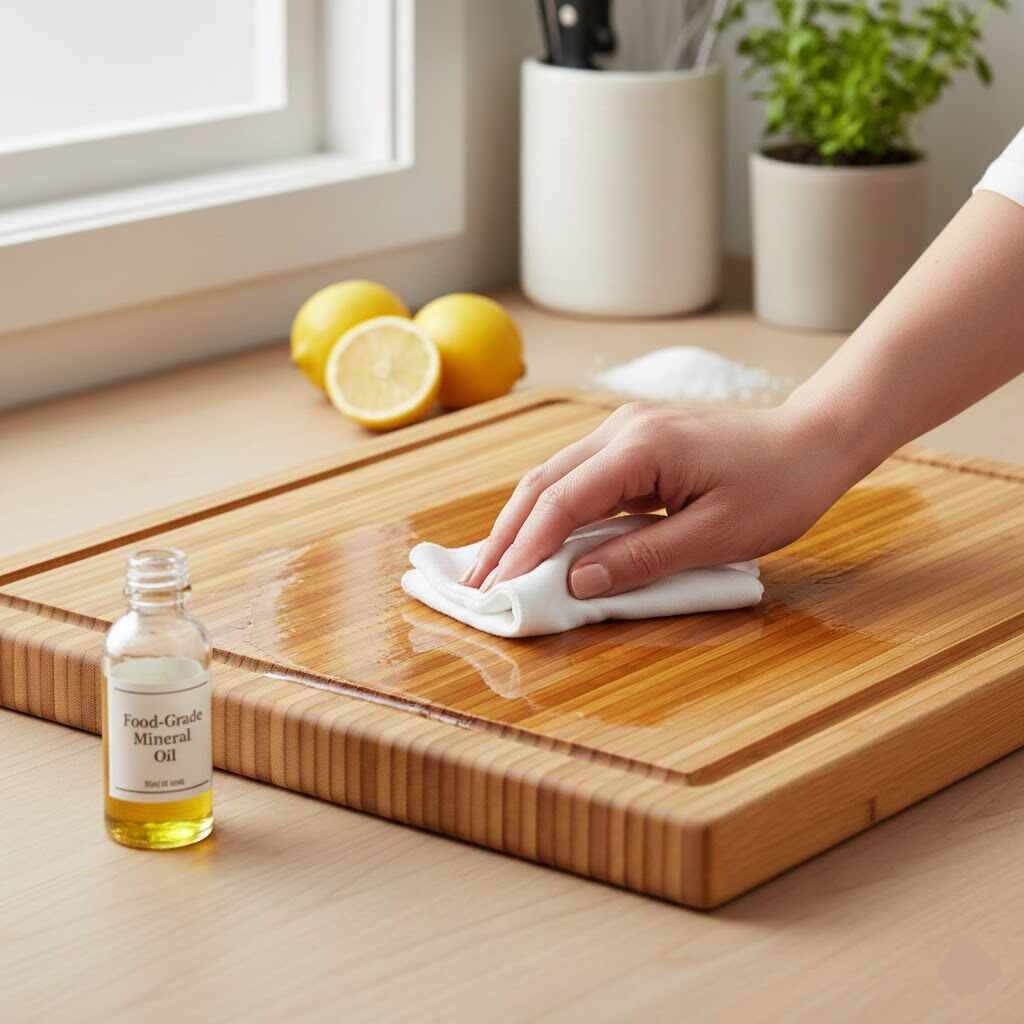
Food-Grade Mineral Oil: The Standard Choice
- Nature: A petroleum-derived liquid composed of long-chain alkanes.
- Pros: Inexpensive and readily available (sold in pharmacies, typically as a laxative); food-safe and completely odorless; never spoils; easy to apply.
- Cons: Does not cure or polymerize—remains liquid indefinitely; washes off more quickly with each cleaning; requires frequent reapplication; limited water resistance compared to drying oils.
- Best for: Daily maintenance and users who prefer quick, simple care routines.
Pure Tung Oil: The Premium Solution
- Nature: A plant-based drying oil extracted from tung tree seeds, containing approximately 80% α-eleostearic acid with three conjugated double bonds.
- Pros: Polymerizes through oxidation, creating a hard, durable coating within fibers rather than just floating on the surface; superior water resistance—establishes a true waterproof barrier; long-lasting protection (oiling intervals can stretch to months rather than weeks); enhances bamboo’s natural grain and color; food-safe once fully cured.
- Cons: Requires 24+ hours drying time per layer; full curing takes weeks (though surface is usable after drying); more expensive than mineral oil; must use “pure tung oil,” not “tung oil varnish” containing drying agents and additives.
- Best for: Users seeking maximum protection with minimum maintenance frequency, or for high-end boards.
Refined Coconut Oil: A Natural Compromise
- Nature: Fractionated coconut oil with long-chain fatty acids removed (medium-chain triglycerides).
- Pros: Naturally antibacterial; doesn’t spoil like regular coconut oil; pleasant soft sheen; better penetration than mineral oil.
- Cons: More expensive than mineral oil; still requires regular reapplication; must be refined—virgin coconut oil spoils and develops off-odors.
- Best for: Users seeking natural alternatives and willing to accept moderate maintenance.
Beeswax and Oil Blend: The Finishing Touch
- Nature: A combination of mineral oil and beeswax (typical ratio 4:1).
- Pros: The wax component adds a water-repellent surface barrier; produces an attractive satin finish; longer-lasting protection than oil alone; easy to make at home.
- Application: Apply as a final sealing layer after oil treatment.
What to Avoid
Never use these oils on cutting boards:
- Olive oil, canola oil, or other cooking oils: They contain triglycerides that oxidize and spoil, producing unpleasant odors and flavors.
- Boiled linseed oil: Contains metallic drying agents (toxins) unsuitable for food contact.
Step-by-Step Oiling Guide
For First-Time Board Breaking In (New Board)
- Thorough Cleaning: Wash with warm water and mild dish soap, rinse thoroughly.
- Completely Dry: Wipe with a towel, then stand upright to air dry for 2–4 hours.
- Gently Warm the Oil (Optional): Heat mineral oil to 90–100°F to reduce viscosity and improve surface spread.
- Generous Application: Pour oil directly onto the board—enough to make the entire surface gleam.
- Uniform Coverage: Using a clean, lint-free cloth, rub overlapping strokes in the direction of the grain.
- Don’t Forget Edges and Bottom: Apply to all surfaces, including sides and underside.
- Let Absorb: Allow oil to soak for at least 4 hours, preferably overnight.
- Wipe Excess: Dry off any surface oil that remains with a clean cloth.
- Repeat: Perform 2–3 more applications during the first week.
For Routine Maintenance Oiling
Follow the same process, though a single application usually suffices. If the board looks particularly dry or feels rough, consider two consecutive treatments.
Daily Care: Cleaning Without Destroying Your Progress
Proper cleaning maintains hygiene while preserving the oil coating—a delicate balance bamboo board users must master.
The Golden Rules of Bamboo Board Cleaning
Do’s:
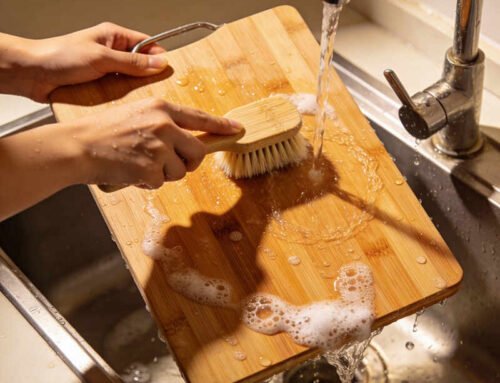
- Hand wash immediately after each use with warm (not hot) water and mild dish soap.
- Use a soft sponge or cloth—never steel wool or abrasive brushes.
- Rinse thoroughly to remove all soap residue.
- Dry immediately with a clean towel.
- Stand on edge to air dry, allowing airflow to all surfaces.
Don’ts:
- Never soak bamboo boards or leave them submerged for extended periods.
- Never put in the dishwasher—heat and prolonged steam exposure cause warping and cracking.
- Avoid harsh chemicals, except for occasional deep sanitization (diluted bleach is acceptable).
Deep Cleaning and Stain Removal
For stubborn stains or odors, skip chemicals and use this natural method:
- Sprinkle coarse sea salt on the stain.
- Cut a lemon in half and use it as a brush, scrubbing in circles while squeezing juice.
- Let sit 5–10 minutes.
- Rinse thoroughly and dry completely.
- Re-oil after deep cleaning.
Sanitizing After Cutting Raw Meat: Wipe with white vinegar or diluted bleach (2 quarts water plus 1 teaspoon bleach), then rinse thoroughly.
Solving the “Grain Raising” Problem: When Your Board Becomes Rough
One of the most common complaints about bamboo boards is a rough, fuzzy texture after washing. This happens when moisture causes bamboo fibers to swell and lift from the surface—a phenomenon called “grain raising.”
Why It Happens
Bamboo fibers have exceptional tensile strength. When severed during use and exposed to moisture, the broken fiber ends absorb water, swell, and stand up like tiny hairs. As the board dries, these fibers don’t fully return to position, creating a rough, crumbling surface.
Solutions: Controlled Grain Raising and Sanding
Traditional Method (Dry Sanding):
1.Sand with 220-grit paper in the direction of the grain.
2.Vacuum or brush away dust.
3.Wipe with a damp cloth to “raise” remaining fibers.
4.Air dry 20–30 minutes.
5.Lightly re-sand with 220-grit.
6.Oil immediately.
Advanced Technique (Oil Sanding): Recommended by woodworking professionals for superior results:
1.Apply a thin coat of mineral oil to the dry board surface.
2.While still oiled, sand with 400–600 grit wet/dry paper.
3.The oil acts as a lubricant, combining with bamboo dust to form a fine slurry.
4.This slurry fills micropores, adhesive gaps, and vascular bundle openings.
5.Oil prevents fiber tearing—fibers are cut cleanly.
6.Wipe away slurry and excess oil.
7.After drying, apply fresh oil coat.
The result is an extremely smooth, nearly polished surface with enhanced water resistance.
Hidden Challenges: Why Bamboo Is More Demanding Than Wood
Despite marketing claims that bamboo is “low-maintenance,” the reality is more complex. Several factors make bamboo boards more demanding than traditional hardwood:
1.Surface-Only Protection:
Because oil cannot penetrate deeply, the protective layer is thin and easily washed away. Deeply saturated wooden boards maintain protection even with surface wear.
2.Silica Content and Abrasiveness:
Bamboo accumulates silicon dioxide in cell walls during growth, forming microscopic mineral deposits. These deposits have a Mohs hardness of 7, harder than most kitchen knife steel (5.5–6.5). This makes bamboo more knife-damaging than traditional hardwoods. Research shows knives dull 20–30% faster on bamboo than on maple or walnut.
3.Adhesive Line Vulnerability:
The glue bonding bamboo strips is the board’s weakest link. Formaldehyde-based adhesives common in low-quality boards break down with repeated water contact and temperature fluctuations.
4.Shorter Lifespan:
Well-maintained bamboo boards can last several years to a decade, but typical lifespan is 2–3 years. By comparison, quality hardwood boards last 5–10+ years with similar care.
Hygiene Concerns: Is Bamboo Really Antimicrobial?
One of bamboo’s most touted advantages is its purported natural antibacterial property. What does the science actually say?
-
Evidence of Antimicrobial Activity:
Bamboo contains a substance often called “bamboo kuhn” that shows antibacterial activity in laboratory studies. Research confirms that bamboo surfaces can suppress E. coli and Salmonella growth under specific conditions. Additionally, its relatively non-porous surface provides fewer hiding places for bacteria.
-
Comparative Hygiene Research:
Multiple studies comparing wood, bamboo, and plastic show hardwood boards are generally more hygienic than plastic, even when both are dishwasher cleaned, because wood has natural antimicrobial and anti-scratch properties. Bamboo performs similarly to hardwood, with some studies giving it a slight edge due to lower porosity.
-
Hygiene Bottom Line:
When properly cleaned and maintained, bamboo boards are hygienic—even better than plastic. But the “natural antimicrobial” marketing shouldn’t be over-trusted: regardless of material, regular cleaning remains essential.
The Environmental Case: Is Bamboo Really More Eco-Friendly?
-
Legitimate Environmental Advantages:
Bamboo grows rapidly (matures in 3–5 years vs. 20–50 for hardwoods); regenerates after harvest with no replanting required; absorbs significant CO2 during growth; requires minimal agricultural inputs (rarely needs pesticides or fertilizer); biodegrades naturally at end of life.
-
Nuanced Differences:
If a bamboo board lasts only 3 years while a hardwood lasts 10, full-lifecycle analysis becomes complicated. Additionally, processing bamboo requires more industrial treatment than milling solid wood (gluing, pressing, heat treatment). Nevertheless, for environmentally conscious consumers, bamboo remains preferable to plastic or old-growth hardwood.
When Bamboo Boards Make Sense (and When They Don’t)
Based on the above assessment, here’s honest advice:
Bamboo Boards Are Good For:
- Budget-conscious cooks: Price is 50–70% lower than quality hardwood.
- Environmentally conscious buyers.
- General food prep: Vegetables, fruit, bread, etc.
- Standard kitchen knife users: German-style or inexpensive stainless steel knives better tolerate hard surfaces.
Consider Alternatives If You Have:
- Expensive Japanese kitchen knives: High-hardness (HRC 60+) thin blades dull extremely quickly on bamboo.
- A “buy it once, use it forever” mindset: Invest in thick maple, walnut, or acacia end-grain boards.
- Heavy chopping needs: Impact can shock open bamboo board adhesive lines.
Your Maintenance Timeline: A Practical Rhythm
- First Week (New Board): Day 1 clean, dry, and heavy oil overnight; Day 3 second oil sealing; Day 7 third oil sealing.
- Monthly: Perform water drop test; deep clean with salt and lemon as needed; re-oil; inspect for cracks.
- As Needed: Sand when surface becomes rough; apply 2–3 consecutive oil coats after sanding.
- Signals It’s Time to Replace: Knife gouges deeper than 2mm; adhesive lines cracked or board delaminating; cracks deeper than half the board’s thickness; odors that won’t wash out.
Conclusion: Yes, Oil Your Bamboo Board
Bamboo cutting boards absolutely require regular oiling, but for fundamentally different reasons than wooden boards. You’re not deeply nourishing; you’re establishing a surface barrier protecting the composite structure from water damage.
Remember: Oil at least once monthly; choose oil wisely; stand upright after washing to air dry. For most home cooks, with proper care, bamboo cutting boards deliver years of reliable service while protecting the planet.
[…] bamboo boards, proper maintenance requires an approach different from traditional hardwood care.Do bamboo cutting boards need to be oiled? Yes,oil your bamboo cutting […]
Thanks for your comments!