
Do bamboo cutting boards dull knives?
When searching for “whether bamboo cutting boards cause knives to dull,” you will encounter confusing claims. Marketing copy from bamboo cutting board manufacturers claims their products are “gentle on blades,” while knife experts and professional Japanese chefs warn to avoid bamboo cutting boards entirely. This article cuts through the contradictory information by examining the material science behind the interaction between knives and cutting boards, presenting experimental evidence, and providing practical guidance to protect your kitchen investment.
The Hardness Paradox: Why Common Metrics Mislead
Most articles discussing the impact of bamboo on knives cite a single metric: the Janka hardness test. Bamboo typically scores around 1,400–1,410 pounds-force (lbf), comparable to Hard Sugar Maple at 1,450 lbf. A surface comparison suggests that bamboo should perform similarly to maple, which is one of the most respected cutting board materials. However, this analysis fundamentally misunderstands the principles of how knives become dull.
The Janka test measures indentation hardness—the force required to embed an 11.28 mm steel ball halfway into the wood. This metric indicates the material’s resistance to denting and compression, which is important for cutting board durability, but it tells us almost nothing about blade wear.
Key Difference: Compression vs. Abrasion
Knife dulling occurs primarily through abrasion rather than compression. When a knife edge contacts the cutting surface thousands of times during food preparation, microscopic particles in that surface can act like sandpaper, gradually stripping metal from the blade. Instead of using metrics related to Janka hardness (compression resistance), the relevant measure is Mohs hardness (scratch resistance).
The Hardness Paradox: Bamboo’s microscopic silica particles (Mohs 7) are harder than even high-quality Japanese knife steel (HRC 60–66).
This distinction reveals bamboo’s hidden flaw: phytoliths, microscopic silica deposits ($SiO_2$) that bamboo plants accumulate for structural reinforcement. These silica bodies, also known as “opaline silica” or “plant stones,” have a Mohs hardness of 7—harder than any knife steel used for culinary applications.
To illustrate this:
- German Stainless Steel (X50CrMoV15): HRC 56–58, approximately Mohs 5.5
- Japanese VG-10 Steel: HRC 60–61, approximately Mohs 6.0–6.5
- Premium Japanese Powdered Steel: HRC 63–66, approximately Mohs 6.5
- Bamboo Phytoliths (Silica): Mohs 7
Bamboo silica particles are harder than even the finest Japanese knife steel. This creates what material scientists call “two-body abrasion”—the softer material (knife steel) experiences material removal when in contact with harder abrasive grains (silica) embedded in a relatively soft matrix (bamboo cellulose).
Experimental Evidence: Testing the Impact of Cutting Boards on Sharpness
A controlled study by an Australian knife sharpener provided quantitative evidence for the knife-dulling properties of bamboo. Using calibrated sharpness testing equipment (BESS – Brubaker Edge Sharpness Scale), researchers measured blade degradation after 2,000 cuts on various cutting board materials.
Key findings from the 2,000-cut test:
- Acacia Long-Grain: Minimal dulling; the blade maintained its sharpness.
- Acacia End-Grain: Performed similarly to long-grain (contradicting the myth that “end-grain is always better”).
- Bamboo Long-Grain: No significant dulling even on dense nodes.
- Bamboo End-Grain: Measurable blade degradation; “clearly detrimental” to knife sharpness.
The most surprising finding of this study violates common views regarding end-grain cutting board structures. While end-grain wood boards allow the blade to slide between vertical fibers (reducing abrasion), end-grain bamboo boards present a dense cross-section of vascular bundles—the very structures where silica concentration is highest. Instead of protecting the knife, bamboo end-grain boards subject the blade to maximum abrasive contact.
Why Professional Knife Users Avoid Bamboo
The clearest signal comes from professional culinary circles and specialist knife retailers.Is bamboo good for Japanese knives?A Japanese knife importer noted: “In twenty years, we have never seen a bamboo cutting board in Japan. Bamboo is an inconsistent material—excessively hard in some places and too soft in others—unsuitable for Japanese knives. Using it, you certainly risk damaging your knife”.
This professional consensus reflects practical experience with high-hardness, thin-edged Japanese knives (HRC 60+), which are particularly susceptible to the abrasive characteristics of bamboo. Users of premium Japanese cutlery consistently report faster blade degradation on bamboo compared to traditional hardwoods.
Damage Modes: Rolling vs. Micro-Chipping
The type of damage caused by bamboo cutting boards is fundamentally different from that caused by softer wooden boards:
- Wooden Boards (Maple, Walnut, Cherry) primarily cause edge rolling—the knife edge slightly bends to one side without metal removal. This damage can be easily corrected with a honing steel, which realigns the bent edge without removing material.
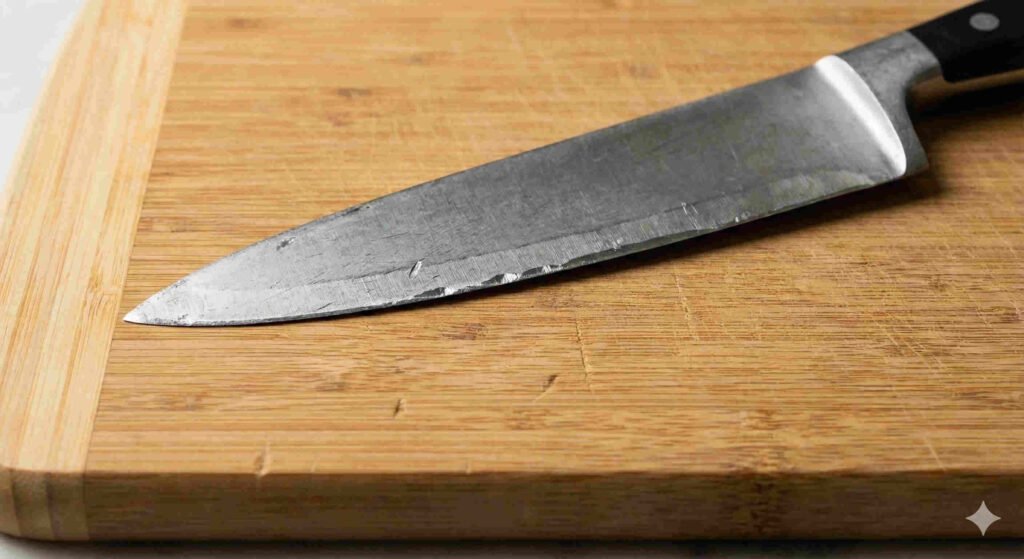
- Bamboo Boards cause micro-chipping and abrasion—actual removal of steel particles from the blade edge. This damage cannot be corrected by honing; it requires re-sharpening with whetstones to remove metal and recreate the blade geometry. Knives used on bamboo boards require approximately 20% more frequent sharpening than those used on traditional hardwoods.
The Glue Factor: Bamboo’s Composite Structure
Unlike solid hardwood boards, bamboo cutting boards are engineered composites—strips of bamboo laminated together with industrial adhesives. This structure introduces an additional source of blade wear that standard cutting board comparisons overlook.
Adhesive Hardness and Density
Modern bamboo boards typically use one of three adhesive systems:
- PVA (Polyvinyl Acetate): Food-safe, but has poorer water resistance.
- Urea-Formaldehyde Resin: Harder when cured, may release formaldehyde.
- Phenolic Resin: High water resistance, creates a hard surface.
When these adhesives cure, they form hard, glassy polymer networks. In edge-grain bamboo boards (the most common construction), glue lines appear every 5–10 mm. Every time a knife passes through the board, the edge transitions between the relatively soft bamboo tissue and the hard resin strips—this creates uneven resistance and accelerates blade fatigue.
End-grain bamboo boards significantly exacerbate this problem. To construct a 3 cm thick end-grain board from bamboo with a natural wall thickness of only 5–10 mm, manufacturers must glue thousands of small bamboo pieces together vertically. The resulting glue volume fraction can exceed 30%—essentially creating a bamboo-reinforced polymer composite rather than a natural wood product.
Health and Safety Considerations
Lower-quality bamboo boards may use adhesives containing formaldehyde. While the FDA requires food-contact adhesives to be fully cured (and thus not leak chemicals), concerns regarding long-term exposure remain, especially as the board ages and adhesive bonds begin to fail. Consumers should look for boards explicitly certified as formaldehyde-free or manufactured with FDA-approved food-safe adhesives like Titebond III.
Knife Matching: Which Blades Suffer the Most?
Not all knives suffer equal damage from bamboo cutting boards. The relationship between knife steel properties and board material determines susceptibility to blade degradation.
High-Risk Knives (Avoid Bamboo)
- Japanese Knives with HRC 60+
- Steel Types: VG-10, AUS-10, SG2, R2, Blue Steel, White Steel.
- Edge Angle: Typically 10–15 degrees per side.
- Damage Mode: Micro-chipping along the edge, visible under magnification.
- Why they are vulnerable: High hardness makes these steels brittle; thin blade geometry provides minimal steel volume to absorb abrasion.
These premium knives sacrifice toughness for edge retention and sharpness. The same hardness that allows them to hold a razor-sharp edge for a long time makes them prone to brittle fracture from silica particles. Bamboo’s silica content creates the exact conditions that promote micro-chipping in hard, thin-edged blades.
Medium-Risk Knives (Acceptable, requires frequent maintenance)
German-style Stainless Steel Knives HRC 56–58
- Steel Types: X50CrMoV15, 1.4116.
- Edge Angle: Typically 18–22 degrees per side.
- Damage Mode: Faster edge dulling than on wooden boards; primarily metal removal rather than rolling.
- Why they are tougher: Lower hardness provides toughness; thicker blade geometry distributes force over more steel.
Standard German kitchen knives trade some edge retention for increased durability and ease of maintenance. Their softer steel (HRC 56–58 vs. Japanese 60–66) and thicker blade geometry make them less prone to catastrophic damage on bamboo boards. However, they still experience accelerated dulling compared to use on traditional hardwoods.
Task Appropriate Use
If you already own a bamboo cutting board, please reserve it for tasks that match the knife’s characteristics:
Acceptable Uses:
- Heavy work with inexpensive knives: Butchering, root vegetable preparation, tasks requiring aggressive cutting.
- Soft food preparation: Bread slicing, herb cutting, fruit cutting (minimal cutting force).
- Dedicated functional boards: Keep bamboo boards as auxiliary boards for non-precision work.
Avoid on Bamboo:
- Precision cutting: Sushi, vegetable julienne, any task requiring razor sharpness.
- Premium knife use: Any knife costing over $100 or with a hardness exceeding HRC 60.
- Daily food preparation: If you cannot easily access sharpening services.
The Maintenance Paradox: Why Bamboo Resists Oil?
In addition to knife damage, bamboo boards present maintenance challenges stemming from fundamental botanical differences between bamboo (grass) and hardwoods (trees).
Missing Ray Cells
Hardwoods contain ray cells—specialized tissues that transport nutrients laterally across the wood grain. These cells create microscopic channels perpendicular to the grain, allowing oil to penetrate deep into the wood structure. When you oil a maple or walnut board, these ray cell channels act as capillaries, drawing mineral oil into the interior to replenish wood fibers and prevent moisture-related cracking.
As a monocotyledonous grass, bamboo completely lacks ray cells. Water and nutrient transport occur exclusively through vertical vascular bundles. In radial and tangential directions (the surfaces you see on end-grain and face-grain boards), bamboo tissue is essentially impermeable. Oil applied to a bamboo surface cannot penetrate; it only coats the exterior.
This anatomical reality explains users’ frustration with bamboo board maintenance:
- Oil application requires frequent repetition (monthly compared to quarterly for hardwoods).
- The board feels “greasy” on the surface while remaining dry inside.
- A single wash removes most of the protective oil layer.
Glue Barriers
Even if oil could penetrate the first bamboo strip in a laminated board, the adhesive layers between strips create an absolute barrier to further migration. The concept of “deep conditioning” that works for hardwood boards has no physical basis for laminated bamboo construction.
Effective Bamboo Cutting Board Maintenance
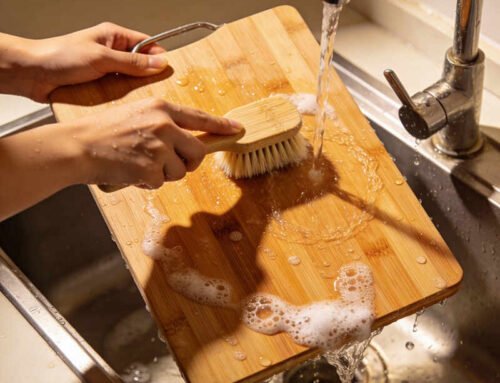
For those committed to using bamboo boards, proper maintenance requires an approach different from traditional hardwood care.Do bamboo cutting boards need to be oiled? Yes,oil your bamboo cutting board.
Oil Selection: Sealing vs. Penetrating
Mineral Oil (Standard Recommendation)
- Chemical properties: Long-chain alkanes; chemically inert, non-drying.
- Bamboo performance: Forms a temporary surface coating; washes off quickly.
- Application frequency: Monthly or after every heavy wash.
- Best for: Users willing to maintain a regular oiling schedule.
Polymerizing Oils (Advanced Option)
- Types: Pure tung oil, polymerized linseed oil.
- Chemical properties: Unsaturated fatty acids that oxidize and cross-link into a polymer film.
- Bamboo performance: Creates a durable waterproof surface layer; lasts 6–12 months.
- Disadvantages: Requires 2–4 weeks to fully cure; requires multiple thin coats.
- Application: Thin coats every 24 hours, applied 3–5 times; allow full cure before food contact.
- AVOID: Edible oils (olive, vegetable, canola)—these contain unsaturated fats that oxidize into rancid compounds, producing unpleasant odors and potential bacterial growth.
The Fuzzy Texture Problem: Wet Sanding Technique
A common complaint about bamboo boards is the “fuzzy” or rough texture that develops after washing. This happens when water causes bamboo fibers to swell and stand upright. Traditional dry sandpaper often worsens the problem by tearing rather than cutting the tough bamboo fibers.
Professional Restoration Method:
- Thorough Cleaning: Wash with mild soap, rinse, and dry completely (24+ hours).
- Oil Application: Apply a generous coat of mineral oil or tung oil to the surface.
- Wet Sanding: Using 220–320 grit wet/dry sandpaper, sand the oily surface along the grain with light, even strokes.
- The Science: The oil lubricates the sanding process, preventing fiber tearing. Sandpaper debris mixes with the oil to form a slurry that fills micro-fissures and vascular bundle openings.
- Final Conditioning: Wipe clean, apply a fresh coat of oil, allow it to absorb for 15–20 minutes, then wipe dry.
This technique produces a significantly smoother surface than dry sanding and creates better oil retention by filling surface irregularities.
Preventing Warping and Cracking
The composite structure of bamboo makes it particularly susceptible to moisture-related distortion.
Key Rules:
- NEVER Dishwasher: High heat and prolonged moisture exposure cause adhesive failure and catastrophic warping.
- NEVER Soak: Even short soaks (>5 minutes) allow uneven moisture absorption, creating internal stress.
- Dry Vertically: Stand the board on its edge immediately after washing to allow airflow to both sides.
- Avoid Heat Sources: Do not store near ovens, dishwashers, or in direct sunlight.
The fundamental problem is that bamboo strips in a laminated board have different grain orientations and moisture absorption rates. When one face absorbs water while the other remains dry, differential expansion leads to cupping (warping). Glue lines prevent the board from naturally equalizing moisture content, making warping more severe and permanent than in solid wood boards.
Superior Alternatives: Choosing the Right Cutting Board
For those prioritizing knife life, several alternatives to bamboo offer better performance with comparable or superior characteristics.
For Japanese Knives (HRC 60+): Japanese Hinoki Cypress
Material Properties:
- Hardness: Soft (significantly lower than bamboo and maple).
- Silica Content: None (softwood).
- Knife Wear: Minimal; edges stay sharp 2–3 times longer than on bamboo.
- Self-healing: Small knife marks close up when damp.
Disadvantages:
- Cost: High-quality boards $100–300.
- Durability: Softwood shows wear faster than hardwood; not suitable for heavy chopping.
- Maintenance: Requires regular oiling and careful cleaning.
Hinoki (Japanese Cypress) is the gold standard for Japanese professional kitchens, especially for sushi preparation. Its extreme softness allows the blade edge to cut between fibers with almost no resistance, preserving the ultra-sharp edges that would quickly degrade on harder surfaces.
For General Use: Hard Sugar Maple
Material Properties:
- Hardness: 1,450 lbf Janka (durable surface).
- Silica Content: Minimal (<0.1%).
- Knife Wear: Low; excellent balance between durability and edge retention.
- Antibacterial Properties: Natural compounds inhibit bacterial growth.
Advantages:
- Cost-effective: High-quality boards $50–150.
- Low maintenance: Less porous than walnut; oiled every 4–6 weeks.
- Professional choice: The most common board in commercial kitchens.
For Premium Knives: Black Walnut
Material Properties:
- Hardness: 1,010 lbf Janka (softer than maple).
- Silica Content: Minimal (<0.1%).
- Knife Wear: Very low; the gentlest edge on common hardwoods.
- Appearance: Rich deep chocolate color with a distinctive grain.
Advantages:
- Knife friendliness: Softer surface reduces blade wear; ideal for HRC 60+ knives.
- Aesthetics: Premium look; suitable for serving/presentation.
- Hides wear: Dark color hides knife marks better than light woods.
Disadvantages:
- Cost: Typically 30–50% more expensive than maple.
- Maintenance: More porous than maple; requires oiling every 3–4 weeks.
End-Grain Advantage (Wood, Not Bamboo)
End-grain construction—where wood fibers stand vertically—offers significant advantages for traditional hardwoods, but not for bamboo. In an end-grain wood board, the blade slides between fiber ends instead of cutting across them, reducing blade wear and visible cut marks. Wood fibers compress slightly under the knife and then bounce back, creating a “self-healing” surface.
This advantage does not transfer to bamboo end-grain boards. As previously noted, bamboo end-grain exposes a high-density, silica-rich cross-section of vascular bundles—the very structure most harmful to blade edges. Australian testing research confirmed that bamboo end-grain boards perform worse for edge retention than bamboo edge-grain boards.
Recommendation: If investing in an end-grain board (typically $150–400), choose hardwood (maple, walnut, cherry) rather than bamboo.
Practical Decision Framework
Choose Bamboo IF:
- Budget is the primary concern ($20–50 vs. $80–200 for high-quality hardwood).
- You use inexpensive knives (HRC 56 or below) for basic food preparation.
- You are willing to sharpen knives frequently (every 2–3 months vs. 6–12 months).
- Environmental priority: Prefer a fast-growing, renewable resource.
Choose Hardwood (Maple/Walnut) IF:
- You own premium knives (>$100 each or HRC 60+).
- You prefer a low-maintenance board requiring quarterly rather than monthly oiling.
- You value edge life: Want to minimize sharpening frequency.
- You need professional-grade durability for heavy daily use.
Choose Hinoki IF:
- You own Japanese knives with a hardness of HRC 62+.
- Precision work: Sushi, sashimi, and fine vegetable work requiring a razor-sharp edge.
- You are willing to accept higher costs and faster board wear for optimal edge retention.
Conclusion: Why “Budget Friendly” Has Hidden Costs
Bamboo cutting boards present a classic case of false economy. While the initial purchase price seems attractive ($20–40 vs. $80–150 for hardwood), the total cost of ownership tells a different story.
Annual Cost Comparison for Average Household Use:
Bamboo Board Scenario:
- Board Cost: $30
- Accelerated Knife Sharpening: 4x/year @ $15 = $60
- Replacement Knives (Premature edge damage): Amortized $50
- Total Annual Cost: $140
Maple Board Scenario:
- Board Cost: $120 (One-time, 10+ year lifespan)
- Normal Knife Sharpening: 2x/year @ $15 = $30
- Knife Life: No premature replacement
- Amortized Annual Cost: $42
This calculation excludes the subjective value of a consistently sharp knife, which significantly improves food preparation efficiency, safety (dull knives require excessive force and slip more easily), and enjoyment.
Material science is clear: the microscopic silica content of bamboo makes it inherently more abrasive to knife edges than traditional hardwoods. While marketing claims highlight that bamboo’s Janka hardness is similar to maple, this metric fundamentally misleads consumers about the actual interaction between knife steel and the cutting surface.
For knife enthusiasts, professional chefs, or anyone who values edge retention, bamboo cutting boards represent a poor investment. Modest cost savings dissipate when considering increased maintenance, accelerated knife replacement, and reduced cutting performance. Traditional hardwoods—particularly maple and walnut—remain the evidence-based choice for preserving knife edges while providing a durable, hygienic cutting surface.
If you currently own a bamboo cutting board, the guidance in this article will help maximize its performance and minimize knife damage. But for future purchases, choose appropriate hardwood alternatives to protect your knives and your culinary experience.
Leave A Comment