
In the jewelry industry, packaging is no longer just a protective shell. It is part of your product, part of your brand story, and for many customers it is the first “touch” they have with your company. A bamboo jewelry box combines sustainability, aesthetics, and durability in one solution, making it a powerful choice for brands that want to upgrade from traditional plastic or synthetic packaging to something more modern and eco‑friendly.
This long‑form guide is written for jewelry brands, retailers, distributors, and packaging buyers who are considering bamboo jewelry boxes for their next project. It explains what bamboo jewelry boxes are, why they work so well for today’s market, how they are made, how to customize them for your brand, and what to look for when choosing a manufacturer. At the end, you will also find a detailed FAQ section answering the most common product‑related questions from B2B clients.
1.Understanding Bamboo Jewelry Boxes
1.1 What exactly is a bamboo jewelry box?
A bamboo jewelry box is a rigid box or organizer whose main structure is made from bamboo materials such as solid bamboo panels, bamboo plywood, or bamboo veneer applied to a core like MDF or paperboard. The box is designed to store and present rings, earrings, necklaces, bracelets, watches, and small accessories. Unlike simple cardboard cartons, these boxes are made to be kept and reused by the end customer, which adds long‑term value to your product.
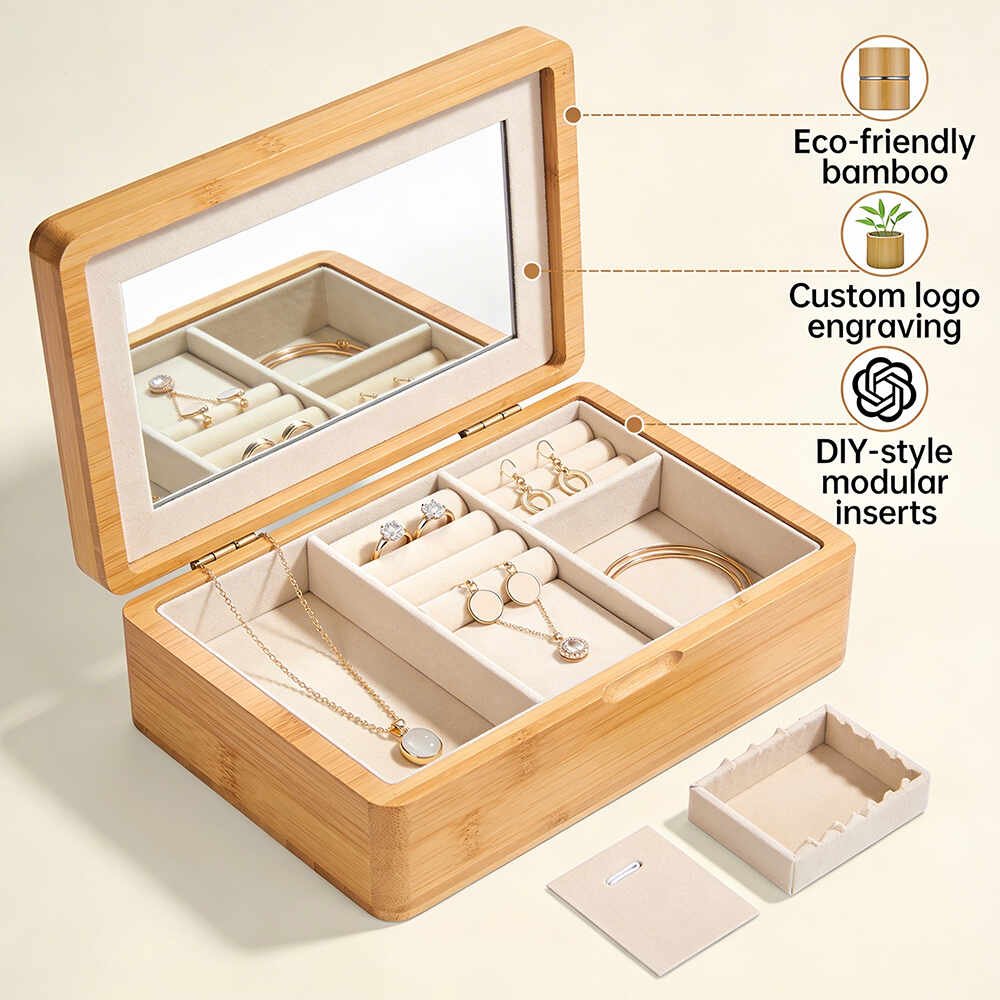
Typically, a bamboo jewelry box consists of three layers: the outer bamboo shell, the interior padding or inserts, and the closing or locking mechanism. The outer shell provides structure and visual impact. The interior materials keep jewelry items secure and protected from scratches. Closures such as magnets, hinges, or clasps ensure a smooth opening and closing experience and reinforce the premium feel.
1.2 Why bamboo, not just “wood”?
Many brands use “wooden jewelry box” as a broad term, but bamboo is technically a grass, not a traditional wood species. This difference matters. Bamboo grows much faster than most trees, reaching maturity within three to five years and regenerating from its root system without the need for replanting. For packaging buyers, this means bamboo can be marketed as a rapidly renewable material, which fits perfectly with modern sustainable‑packaging narratives.
At the same time, processed bamboo boards behave similarly to hardwood in terms of strength and appearance. Modern bamboo panels can be sanded, stained, painted, engraved, and coated just like traditional wood. This gives you the warmth and natural grain of wood while allowing you to communicate a stronger environmental story.
1.3 Key benefits for B2B buyers
From a B2B perspective, bamboo jewelry boxes offer several advantages:
- Strong sustainability positioning compared with plastic and many synthetic materials.
- A distinctive, natural look that supports minimalist, Scandinavian, Japanese, or eco‑luxury brands.
- High durability and reusability, which means your logo stays on the customer’s dressing table for years.
- Wide customization possibilities in size, shape, color, interior layout, and logo application.
- Good compatibility with global shipping and e‑commerce, because rigid bamboo structures protect fragile jewelry in transit.
2.Main Structures and Styles of Bamboo Jewelry Boxes
Different jewelry lines and price points call for different box structures. Below are the most common styles that manufacturers supply to brands and retailers.
2.1 Classic hinged box
The classic hinged bamboo jewelry box is very close to what many people imagine when they think of a “signature” jewelry box. The lid and base are connected with small metal hinges or hidden hinges, and the interior holds a padded insert.
Key features:
- Compact sizes for single pieces, such as 60–70 mm ring boxes, 80–100 mm pendant boxes, and 200–250 mm bracelet boxes.
- Thick bamboo walls and stable construction, suitable for premium retail display and gifting.
- Interior inserts in velvet, microfiber, linen, or PU leather, shaped specifically for rings, studs, or pendants.
- Optional inside logo on the inner lid to strengthen the brand impression when the box is opened.
This structure is popular for engagement rings, wedding jewelry, and high‑value items where the opening moment needs to feel special and ceremonial.
2.2 Drawer‑type jewelry box
Drawer‑type bamboo boxes look more like small furniture pieces than simple packaging. They use one or several sliding drawers, often combined with a top lid or tray.
Advantages:
- Multi‑layer storage for complete jewelry sets or multiple SKUs in one unit.
- Easy daily use for end customers, making the box a permanent part of their home décor.
- Good canvas for branding through engraved handles, printed fronts, or custom‑color interior compartments.
This style is often chosen by lifestyle brands and home‑organization retailers, as well as by jewelry subscription services that want the box to become an everyday organizer.
2.3 Stackable modular boxes
Stackable bamboo jewelry boxes consist of several separate trays or modules that can be stacked vertically. Each layer usually has a different compartment layout: ring slots, grid compartments, open trays, or watch pillows.
Benefits:
- Customers can start with one or two layers and then buy additional modules as their collection grows.
- From a B2B standpoint, you can design one core size and several insert variations, making production and inventory more efficient.
- Stackability makes this format attractive for minimalist and modern brands that prefer flexible systems over single fixed boxes.
Because of the modular nature, this style also works very well for cross‑selling and upselling strategies in e‑commerce.
2.4 Organizer trays and in‑drawer inserts
Organizers and in‑drawer bamboo inserts are shallow trays designed mainly for display and storage rather than individual gifting. Jewelry stores, department stores, and showrooms use them in vitrines, drawers, and safe boxes.
Typical specifications include rectangular trays with standard footprints (for example, 28 × 19 × 3 cm or similar), fitted with ring slots, earring pads, or grid partitions. These trays can be stacked on top of each other or slid into cabinets. Brands that want a consistent in‑store look often order a full set of matching bamboo trays for both the sales floor and the back room.
2.5 Gift‑ready lid boxes with mixed materials
To control costs while still using bamboo as the hero material, many manufacturers offer mixed‑material boxes where the lid is made of bamboo and the base is made from rigid paperboard or MDF wrapped in paper. This reduces weight and material cost but keeps the visual impact of natural bamboo on top.
This style is popular for:
- Mass‑market fashion jewelry.
- Corporate gifts and promotional sets.
- Online brands that need a balance between perceived value and shipping cost.
Even with a mixed structure, you can still engrave, print, or foil your logo on the bamboo lid and use eco‑friendly papers and inks on the base.
3.Materials, Finishes, and Interior Options
3.1 Types of bamboo panels
For jewelry boxes, manufacturers commonly use:
- Natural light bamboo, which has a pale yellow tone and clearly visible grain.
- Caramelized or “smoked” bamboo, which looks warmer and darker, similar to certain hardwoods.
- Colored or painted bamboo, where the panels are stained or coated to match specific brand colors.
Panels can be laminated horizontally or vertically, which slightly changes the direction and density of the grain pattern. Choosing the right combination of color and grain helps differentiate your product line in a crowded market.
3.2 Surface finishes
After cutting and assembling, bamboo surfaces must be sanded and finished. Popular finishes include:
- Clear lacquer (glossy or semi‑gloss) for a polished, furniture‑like appearance.
- Matte oil or wax finishes that preserve a natural, soft touch.
- Water‑based coatings with low VOC content for eco‑focused brands.
- Colored stains that tint the bamboo while allowing the grain to remain visible.
When you design your project, it is important to consider how the finish will age. Matte, slightly textured finishes tend to hide small scratches better during daily use, while very glossy coatings may show fingerprints but can look more luxurious in showcases.
3.3 Interior linings and inserts
The inside of a bamboo jewelry box plays a huge role in perceived value and product safety. Common choices are:
- Velvet or velour: classic luxury feel, available in many colors, excellent for rings and high‑value pieces.
- Microfiber: smooth, modern surface that works well for minimalist brands and can be easier to clean.
- Linen‑look fabrics: natural texture that echoes the eco‑friendly message of bamboo.
- PU leather: sleek, structured appearance, often used in men’s jewelry and watch boxes.
- Recycled or organic fabrics: increasingly popular among conscious consumers.
Inserts can be fixed or removable. Fixed inserts are cost‑effective and stable. Removable trays or cushions provide more flexibility, such as converting a ring box into a general storage box when the jewelry is not inside.
3.4 Hardware and functional details
Small details make a big difference in user experience:
- Hidden or visible hinges determine how wide the lid opens and whether the mechanism is visible.
- Magnets can be embedded in the lid and base to create a smooth, silent closing action.
- Metal clasps or locks add a traditional, box‑like character and emphasize security.
- Knobs and pulls on drawers can be made from bamboo, metal, leather, or resin to match your brand styling.
Thinking through these details early in the design process helps ensure that the finished box feels coherent and well thought out, rather than assembled from random components.
4.Branding and Customization for Your Project
4.1 Choosing the right logo technique
There are four main ways to put your logo and artwork on a bamboo jewelry box:
- Laser engraving– This technique burns the design directly into the bamboo surface, creating a crisp, permanent mark. It suits minimalist brands and eco‑focused projects because it requires no additional inks or foils.
- Silk‑screen printing– Best for solid‑color logos and simple graphics. It offers strong color and is economical for larger quantities.
- Hot stamping / foil stamping– Uses a heated die and metallic or colored foil to create a shiny, embossed look. It is ideal for luxury collections and special editions where you want strong shelf impact.
- UV digital printing– Allows full‑color photographs, gradients, and complex artwork on the lid or sides. This method is perfect for limited editions, artist collaborations, or campaigns.
You can also mix techniques, for example combining a laser‑engraved logo with subtle foil details, or using UV printing on outer sleeves while keeping the bamboo surface pure.
4.2 Brand‑consistent color schemes
A good bamboo jewelry box project considers both the outer and inner color palette. For eco‑luxury brands, a common combination is natural bamboo outside with cream, beige, or muted earth tones inside. For fashion‑forward brands, contrasting inner linings—such as pastel velvet or bold jewel tones—can make the jewelry pop when the box is opened.
When you brief your manufacturer, provide brand guidelines or Pantone references if possible. Many factories can dye fabrics or print paper to approximate your colors, especially at higher order quantities.
4.3 Structural customization
Beyond appearance, structure is another major customization lever. You can:
- Adjust wall thickness for more substantial or lighter boxes.
- Change the height of lids and bases to create unique silhouettes.
- Combine different modules (for example, a drawer base plus a hinged lid).
- Add internal compartments to hold multiple pieces or additional items such as certificates, polishing cloths, or small brochures.
A well‑designed structure supports your sell‑through strategy. For example, if you bundle small accessories with a main jewelry item, designing a dedicated slot for the extra item helps you keep presentation neat and consistent in every box.
5.From Idea to Finished Product: Typical OEM/ODM Workflow
If you have never developed custom bamboo packaging before, the process can look intimidating. In reality, the steps are straightforward once you understand the typical workflow.
5.1 Initial brief and quotation
You start by sending a clear brief to your supplier or manufacturer. This should include:
- Intended products (ring, necklace, set, watch, etc.).
- Target retail price range of your jewelry (to align box cost and perceived value).
- Preferred style (hinged, drawer, stackable, tray).
- Rough dimensions or maximum size constraints.
- Preferred materials and colors.
- Estimated order quantity and target budget.
Based on this information, the manufacturer suggests suitable structures and materials and provides an initial quotation. At this stage it is usually fine if every detail is not final yet; the quotation gives you a sense of the cost range and helps you choose a direction.
5.2 Design development and 3D drawings
Once a direction is chosen, the manufacturer’s design team or engineer will create technical drawings and sometimes 3D renderings. These documents show all dimensions, wall thicknesses, insert layouts, logo positions, and hardware placements. You check these drawings against your brand’s needs and make revisions until everything is aligned.
This step is crucial because correcting structural mistakes after sampling or, worse, after mass production is expensive. Spend enough time confirming that your jewelry fits perfectly and that there is enough space for fingers to remove items comfortably.
Some brands want a more flexible, bamboo jewelry box DIY concept, where the end customer can rearrange inserts, add stickers or customize the lid with their own engraving at a local store.
5.3 Sampling
When drawings are approved, the factory produces physical samples. There are usually one or two rounds:
- Structure sample– Focuses on size, shape, and mechanism; interior materials and colors may be temporary.
- Pre‑production sample– Uses the same materials, finishes, and logo processes as the final product.
You should test samples with real jewelry pieces, check opening and closing feel, look for imperfections in finishing, and verify that the logo is accurate. Once you approve the final sample, it becomes the benchmark for quality control during mass production.
5.4 Mass production and quality control
In mass production, bamboo panels are cut, assembled, sanded, coated, lined, and decorated according to the approved sample. Better manufacturers have multiple quality checkpoints, including:
- Incoming material inspection (bamboo, fabrics, hardware).
- In‑process inspection during assembly and finishing.
- Final inspection for each batch, checking appearance, dimensions, and function.
Many international buyers arrange third‑party inspections, especially for the first order. Random sampling at AQL levels helps ensure that the shipment is consistent with the agreed standard.
5.5 Packing, shipping, and after‑sales
Finished bamboo jewelry boxes are usually packed in protective polybags or tissue, then placed into inner cartons and master cartons suitable for export. For fragile designs or for shipments traveling long distances by sea, factories may add corner protectors or extra foam.
You can choose between sea freight, air freight, or combined methods depending on your timeline and budget. After receiving the goods, a reliable manufacturer will support you with any issues such as transit damage, minor defects, or reordering needs.
6.Cost, MOQ, and Lead Time Considerations
Many of our clients start with a simple sample order and later move to bamboo jewelry box wholesale programs once their collection performs well in the market.For most B2B buyers, beautiful design is only part of the decision. You also have to manage budgets, timelines, and minimum order quantities (MOQs).
6.1 Typical MOQ levels
While MOQs vary by factory, a common pattern is:
- Around 300–500 pieces per style for fully custom boxes with new dimensions and structure.
- Around 100–300 pieces when you use existing molds or share components with other customers.
- Lower MOQs for stock boxes where only logo engraving or printing is changed.
Higher quantities generally unlock better unit pricing, and in some cases you can negotiate combined MOQs across several related sizes if they share materials and finishes.
6.2 Main cost drivers
The following elements most strongly influence unit price:
- Box size and structural complexity (single ring box vs. multi‑drawer organizer).
- Type and thickness of bamboo, and the complexity of surface finishing.
- Choice of interior materials, such as high‑end velvet vs. simple flocked foam.
- Logo techniques and the number of printing or stamping positions.
- Additional accessories like mirrors, locks, metal corners, or custom gift sleeves.
- Packaging for shipment, including individual gift boxes, dust bags, or protective foam.
By discussing priorities with your manufacturer, you can find cost‑saving opportunities without compromising on your key brand messages. For example, using laser engraving instead of full‑color UV printing may reduce cost while enhancing the natural, sustainable feel of the box.
6.3 Lead times and planning
Lead times depend on design complexity, order quantity, and the factory’s production schedule. As a rough guide:
- Design and sampling: 2–4 weeks including communication and revisions.
- Mass production: 4–6 weeks after sample approval, sometimes longer for large or very complex orders.
- Shipping: about 1 week by air, 3–6 weeks by sea depending on destination.
If you are preparing for major sales seasons such as Valentine’s Day, Mother’s Day, or Christmas, it is wise to start the project at least six months in advance. This allows time for design refinement, sample testing, and possible adjustments.
7.Use Cases and Brand Scenarios
To make the possibilities more concrete, here are several typical scenarios where bamboo jewelry boxes add strong value.
7.1 Eco‑luxury fine jewelry brand
A fine jewelry brand focused on ethical gemstones wants packaging that reflects its values. They choose a small, solid bamboo ring box with a matte finish and cream velvet lining. The lid is engraved with a minimal logo, and inside there is a subtle foil‑stamped emblem. The resulting presentation feels premium yet calm and natural, perfectly aligned with the brand’s promise of responsible luxury.
7.2 Fashion jewelry subscription service
A subscription brand ships monthly sets of earrings and necklaces. They decide on a modular stackable bamboo box system. Every first‑time subscriber receives a base box with two layers; future shipments include an additional tray or insert that customers add to the stack. Over time, subscribers build a personalized jewelry organizer, which reduces packaging waste and increases loyalty.
7.3 Retail chain upgrading in‑store display
A jewelry retail chain with dozens of stores wants a unified, modern display solution. They replace mismatched plastic trays with coordinated bamboo organizer trays for rings, studs, and pendants. The new trays slide into both back‑room drawers and glass cabinets, creating a consistent, warm look that enhances the visual appeal of even lower‑priced items.
7.4 Corporate gifting project
A corporate client needs thousands of gift sets containing a branded bracelet and a small message card. They choose a cost‑effective bamboo‑lid gift box with a paperboard base. The company logo is laser‑engraved on the lid and printed on the card inside. The gift box communicates care for the environment while keeping the overall budget under control.
7.5 If your brand focuses on female customers, a dedicated women’s bamboo jewelry box line with softer colors, mirrors and earring trays can reinforce your positioning and create a more personal unboxing experience.Retailers can also separate men’s watch boxes from a women’s bamboo jewelry box range to make in‑store merchandising clearer and more intuitive.
8.How to Evaluate and Choose a Bamboo Jewelry Box Manufacturer
8.1 Questions to ask potential suppliers
When you shortlist suppliers, ask at least these questions:
- Do you specialize in bamboo products, and what percentage of your production is bamboo jewelry boxes?
- Can you share photos or samples of similar projects completed for other clients?
- What certifications or audits do you hold (FSC, ISO, social compliance, etc.)?
- What are your standard QC procedures, and do you accept third‑party inspections?
- What is your typical lead time for sampling and mass production?
The quality of the answers, and how quickly and clearly they respond, is often a good indicator of how the cooperation will go.
8.2 Evaluating samples
Beyond appearance, test samples practically:
- Check that lids open and close smoothly, with no misalignment or wobbling.
- Inspect corners and edges for cracks, chips, or inconsistent sanding.
- Confirm that finishes are even and that there is no strong chemical smell.
- Insert your real jewelry to see whether it fits securely and looks visually balanced.
- Try putting the sample into a shipping box and simulate a simple drop test to see how it holds up.
A sample that looks good but performs poorly in real use can lead to returns and brand damage later.
8.3 Building a long‑term partnership
The most successful packaging projects gain efficiency over time. Once a manufacturer understands your brand and workflow, they can propose improvements proactively, such as new insert ideas, material alternatives, or ways to reduce costs without losing quality.
Consider:
- Sharing upcoming product roadmaps so the manufacturer can plan capacity.
- Consolidating multiple packaging types with one supplier to benefit from scale.
- Setting up an annual review to discuss quality, lead times, and new design options.
A stable partnership helps you react faster to market trends while keeping your packaging consistent and reliable.
9.Product‑Focused FAQ About Bamboo Jewelry Boxes
Q1: Are bamboo jewelry boxes really eco‑friendly?
Bamboo is one of the fastest‑growing renewable materials available, reaching maturity in just a few years and regenerating from its existing root system. When combined with responsible sourcing and low‑VOC finishes, bamboo jewelry boxes significantly reduce reliance on fossil‑based plastics and slow‑growing hardwoods. However, the overall environmental impact still depends on factors like transport, coatings, and whether the box is reused or discarded, so it is important to design for durability and long‑term use.
Q2: How do bamboo jewelry boxes compare with traditional wooden boxes?
Structurally, processed bamboo panels are strong and stable, comparable to many hardwoods. They are less prone to warping when properly treated and are generally lighter for the same strength. Visually, bamboo has a more uniform linear grain, which suits modern aesthetics, while some hardwoods offer more varied patterns. From a sustainability perspective, bamboo typically performs better due to faster growth and higher renewability.
Q3: What is the typical minimum order quantity (MOQ)?
For fully customized bamboo jewelry boxes with unique dimensions and structures, most manufacturers ask for 300–500 pieces per style as a starting MOQ. If you select an existing structure and only customize colors and logos, the MOQ can often be lowered to around 100–300 pieces. Very low quantities may be possible for stock boxes, but unit prices will be higher and some customization options may be limited.
Q4: How long does it take to develop and receive an order?
If you already have a clear idea of what you need, the development process usually looks like this: one to two weeks for design confirmation and technical drawings, one to two weeks for sampling, four to six weeks for mass production after sample approval, and then shipping time on top. For sea freight, plan an additional three to six weeks depending on your location. Overall, it is sensible to reserve at least three to four months from initial brief to goods arriving at your warehouse.
Q5: Can I have my logo on the box? What are the options?
Yes, you can absolutely add your logo. The most common options are laser engraving directly into the bamboo, silk‑screen printing in one or more spot colors, metallic hot stamping for a high‑end look, and UV digital printing for full‑color artwork. Inside the box, logos can be foil‑stamped or printed on the lining fabric, on a printed card, or on a ribbon. Your choice depends on the desired style, budget, and quantity.
Q6: What kinds of jewelry fit best in bamboo boxes?
Bamboo jewelry boxes can be engineered for almost any jewelry type, including rings, earrings, necklaces, bracelets, bangles, watches, and small accessories like cufflinks. The key is to design the interior insert properly. For example, ring slots should hold rings upright without wobbling, and watch pillows should be sized for both men’s and women’s watches. For mixed sets, inserts with multiple zones ensure that pieces do not touch and scratch during transport.
Q7: How should bamboo jewelry boxes be cared for by the end customer?
End customers should keep bamboo boxes in a dry, ventilated environment away from direct sunlight and extreme humidity. To clean the exterior, a soft, dry or slightly damp cloth is usually enough; harsh chemicals or abrasive pads can damage the finish. If the climate is very humid, adding a small desiccant packet inside drawers can help prevent moisture issues. With basic care, a bamboo jewelry box can stay attractive for many years.
Q8: Are bamboo jewelry boxes suitable for very high‑end fine jewelry?
Yes. Many brands that sell high‑end fine jewelry now embrace bamboo because it supports a modern, responsible‑luxury image. To position bamboo at the high end, combine solid or thick bamboo panels, premium matte finishes, and interior linings such as high‑density velvet or Alcantara‑style microfiber. Adding refined details like soft‑close hinges, hidden magnets, and understated foil accents ensures that the box feels appropriate for expensive pieces.
Q9: Can bamboo jewelry boxes be shipped flat to save space?
Most rigid bamboo jewelry boxes are shipped fully assembled, because the structure is glued and finished as a solid unit. Flat‑packing is common in cardboard packaging but much less so in wooden or bamboo boxes. However, some manufacturers can design knock‑down or partially assembled structures for specific projects, especially for modular organizers. If shipping volume is a major concern, discuss this early with your supplier so they can explore structural solutions or optimized nesting of boxes in cartons.
Q10: What testing or certifications should I ask for?
If you plan to promote sustainability, ask whether the bamboo comes from responsibly managed sources and whether the factory can provide certifications such as FSC for the material. For markets with strict regulations, you may also need test reports for coatings and adhesives to confirm that they comply with relevant chemical‑safety standards. In addition, social‑compliance audits and quality‑management certifications provide extra assurance that your supplier meets your brand’s requirements.
Q11: Can bamboo jewelry boxes be adapted for watches or smart jewelry?
Yes. The same basic structures used for jewelry can be fitted with different inserts for watches, smartwatches, or smart jewelry devices. For example, a square hinged box can be equipped with a larger pillow and cable‑management cutouts for charging cords. Drawer‑type boxes can include wider compartments that hold watch rolls or smart devices alongside traditional jewelry pieces, allowing you to present complete accessory ecosystems in one package.
Q12: Are bamboo jewelry boxes compatible with eco‑friendly outer packaging?
Bamboo jewelry boxes work very well with eco‑friendly outer packaging. Many brands wrap them in recycled‑paper sleeves, ship them in kraft mailer boxes, or include them in reusable cotton pouches. Because the box itself is sturdy, you can often reduce the amount of plastic fillers or foam in your shipping cartons, lowering both environmental impact and material cost.

Leave A Comment