
Disposable bamboo chopsticks are widely used in restaurants, takeout services, catering businesses, food trucks, parties, and homes. They offer a practical way to serve Asian cuisine and many other meals while giving customers a familiar, lightweight, and natural utensil option.
Unlike reusable chopsticks, disposable bamboo chopsticks are intended for short-term food service use. They are commonly packed individually in paper sleeves or plastic wrapping, supplied in bulk cartons, and offered in several lengths, shapes, finishes, and packaging styles. Choosing the right type matters because chopsticks affect food presentation, customer comfort, hygiene, operational efficiency, and purchasing cost.
This guide explains what disposable bamboo chopsticks are, how they are made, how to select them for different food-service situations, what quality factors matter, and how businesses can make more informed purchasing decisions.
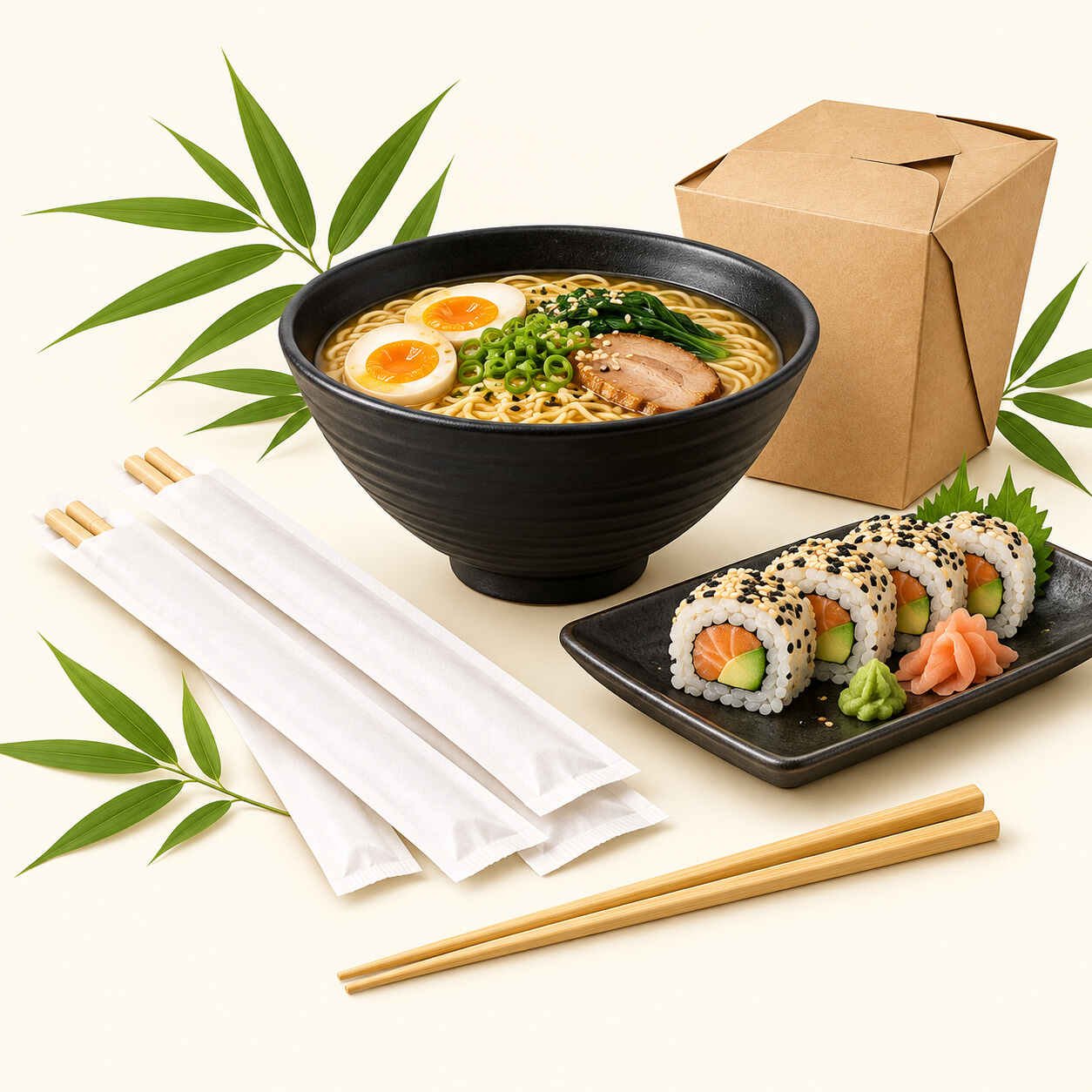
What Are Disposable Bamboo Chopsticks?
Disposable bamboo chopsticks are single-use eating utensils made primarily from bamboo. They are commonly used in restaurants, takeout services, catering, events, and home meals.
Are Bamboo Chopsticks Disposable?
Many bamboo chopsticks are sold as disposable chopsticks, meaning they are intended for one meal or one food-service occasion. However, not every bamboo chopstick is disposable: reusable bamboo chopsticks are also available for household use. Disposable versions are usually lighter, less durable, and often packaged in bulk or individual sleeves.
Why Bamboo Is Used for Disposable Chopsticks
Bamboo is a popular material for disposable chopsticks because it is lightweight, strong for its weight, and widely available. It also has a natural appearance that many customers associate with Asian cuisine, simplicity, and reduced reliance on conventional plastic utensils.
Bamboo grows differently from traditional timber. It is a fast-growing grass rather than a tree, and many bamboo species can regenerate after harvesting when managed responsibly. This characteristic has made bamboo an attractive material for a broad range of products, including kitchenware, skewers, food packaging, furniture, toothbrushes, and disposable utensils.
However, the word “bamboo” should not automatically be treated as proof that a product is environmentally harmless in every circumstance. The overall impact of disposable bamboo chopsticks depends on several factors:
-
How the bamboo was grown and harvested
-
Whether chemicals were used in processing
-
How far the product traveled before purchase
-
Whether it has a paper sleeve, plastic wrapper, or other packaging
-
Whether local waste systems accept the product for composting
-
Whether food contamination prevents composting after use
-
How the chopsticks are disposed of
For buyers, the best approach is to consider bamboo as one useful material choice rather than as a universal environmental claim. Businesses should make clear, accurate statements about the product’s material and avoid promising compostability or biodegradability conditions that they cannot verify.
Common Types of Disposable Bamboo Chopsticks
Disposable bamboo chopsticks may look similar at first, but there are meaningful differences in shape, packaging, size, and finish. Selecting the right format helps match the utensil to the meal, customer type, and service method.
Tensoge Chopsticks
Tensoge chopsticks are connected at the top and separated by the customer before use. They are among the most recognizable forms of disposable chopsticks.
The joining point is designed to make the pair easier to package, transport, and distribute. Customers break the chopsticks apart by gently pulling them in opposite directions.
Tensoge chopsticks are often used in:
-
Casual Asian restaurants
-
Sushi counters
-
Noodle shops
-
Food courts
-
Takeout orders
-
Catering operations
-
Events and festivals
A good pair should separate cleanly. If the connecting point is too thick, it may be difficult to break apart. If it is poorly cut, the chopsticks may split unevenly or leave rough fibers near the top.
Twin Chopsticks
Twin chopsticks are similar to tensoge styles but may have a different joining design, shape, or overall profile. The term can refer to several paired disposable chopstick formats where the sticks remain connected until the customer uses them.
They are practical for businesses that want a compact product with a familiar single-use presentation.
Individually Wrapped Bamboo Chopsticks
Individually wrapped disposable bamboo chopsticks are packed in sleeves made from paper, plastic, or another protective material. They are common in takeout, delivery, restaurant service, and catering because the wrapper helps reassure customers about hygiene.
Paper sleeves can be plain, printed, branded, or customized with:
-
Restaurant names
-
Logos
-
Phone numbers
-
Websites
-
Social-media handles
-
Promotional messages
-
Menu categories
-
QR codes
-
Holiday designs
Individually wrapped options can improve presentation, especially for restaurants that want a more polished customer experience. They may cost more than bulk unwrapped chopsticks, but the packaging can reduce handling concerns and support a more professional appearance.
Unwrapped Bulk Bamboo Chopsticks
Unwrapped disposable bamboo chopsticks are typically sold in large packs or cartons. They are useful for high-volume kitchens, buffet stations, self-service counters, event organizers, and businesses that use separate utensil dispensers.
These products may be more economical per pair, but they require careful storage. Businesses should keep them in clean, dry, covered containers to protect them from dust, moisture, and accidental contamination.
Round Bamboo Chopsticks
Round disposable bamboo chopsticks have a cylindrical or nearly cylindrical shape. They may feel smooth and comfortable in the hand, particularly for customers who are already used to eating with chopsticks.
Round styles are often associated with a simple, natural look. However, very smooth round chopsticks can be harder for beginners to grip, particularly when handling slippery noodles, tofu, sushi, or sauce-coated foods.
Square and Rectangular Bamboo Chopsticks
Square or rectangular disposable bamboo chopsticks provide more defined edges. These shapes can offer improved grip for some users because the flat sides and corners help prevent rolling between the fingers.
They are often used in casual restaurants and takeout service. The shape can also make them easier to stack and package efficiently.
Tapered Bamboo Chopsticks
Tapered chopsticks are thicker at the top and narrower at the food-contact end. This design can provide better control when picking up smaller foods, such as rice, vegetables, noodles, or pieces of sushi.
A tapered tip may improve the dining experience, but it must be finished carefully. A tip that is too thin can break under pressure, while a tip that is too blunt may be less useful for delicate foods.
Choosing the Right Length
Length is one of the most important specifications when buying disposable bamboo chopsticks. Different lengths can affect comfort, food handling, packaging, and perceived product quality.
Common disposable bamboo chopstick lengths include:
-
Approximately 7 inches
-
Approximately 8 inches
-
Approximately 8.25 inches
-
Approximately 9 inches
-
Approximately 9.5 inches
Shorter chopsticks may be suitable for children, snack portions, small rice bowls, tasting events, or compact takeout packaging. Longer chopsticks are often preferred for ramen, noodle bowls, larger meal trays, and restaurant dining.
8-Inch Disposable Bamboo Chopsticks
An 8-inch format is a common middle-ground choice. It can work well for standard takeout meals, casual dining, and general-purpose food service.
This size is compact enough for many packaging formats but still long enough for most adult customers to eat comfortably. It may be a practical choice for restaurants that serve a wide range of dishes and want one versatile utensil size.
9-Inch Disposable Bamboo Chopsticks
Nine-inch disposable bamboo chopsticks are often preferred for larger meals and bowls. They can provide extra reach and control for noodle dishes, ramen, hot pots, and substantial rice bowls.
Longer chopsticks can also create a more premium impression. For restaurants serving full meals rather than small snack portions, this size may better match customer expectations.
9.5-Inch Disposable Bamboo Chopsticks
A 9.5-inch option is often associated with more substantial restaurant service. It may be suitable for high-volume Asian restaurants, sushi restaurants, ramen shops, and catering businesses that want a full-size utensil.
Before choosing this length, buyers should confirm that it fits into their takeout bags, meal containers, sleeve designs, and utensil kits. A longer chopstick may offer better functionality, but it can be inconvenient if it does not fit the packaging system.
Quality Factors That Matter
Disposable bamboo chopsticks should be simple, but simple does not mean unimportant. Quality differences are often immediately noticeable to customers.
A restaurant can invest in attractive packaging and high-quality food, yet still damage the experience if the included chopsticks feel rough, weak, or poorly made. Evaluating a few practical quality factors can help prevent this problem.
Surface Smoothness
The chopsticks should feel smooth from end to end. Rough areas can make them uncomfortable to hold and may create concern about splinters or poor manufacturing quality.
Check whether the chopsticks have:
-
Rough grain
-
Sharp edges
-
Loose fibers
-
Uneven sanding
-
Visible cracks
-
Splintered ends
-
Excessive surface dust
A smooth finish is especially important for individually wrapped chopsticks, because customers often associate wrapping with cleanliness and quality. A wrapped product that feels rough or unfinished can create a disappointing contrast.
Splinter Resistance
One of the most important quality features is resistance to splintering. Bamboo chopsticks should remain intact when separated, held firmly, and used with typical meals.
Splintering can occur because of low-quality material, poor drying, weak grain structure, uneven cutting, or inadequate finishing. It is particularly important to test the top connection point on joined chopsticks.
A business should test sample batches by separating multiple pairs and checking whether the chopsticks:
-
Break evenly
-
Remain straight
-
Produce rough fibers
-
Crack along the grain
-
Leave sharp fragments
-
Feel balanced after separation
Strength and Rigidity
Disposable bamboo chopsticks do not need to be as thick or durable as reusable chopsticks, but they should not bend excessively under normal use.
Strength matters for foods such as:
-
Thick noodles
-
Fried chicken pieces
-
Dumplings
-
Sushi rolls
-
Vegetables
-
Rice bowls
-
Grilled meat
-
Tofu
-
Tempura
Thin chopsticks may reduce material use and shipping weight, but if they feel fragile, customers may struggle to eat comfortably. For restaurants, the most economical product is not always the one with the lowest purchase price. If customers request extra utensils because the first pair breaks, the true cost rises.
Straightness
Chopsticks should be reasonably straight and evenly matched. A visibly warped pair can feel awkward and may be more difficult to use.
Slight natural variation can occur in bamboo products, but substantial bending or twisting may indicate poor storage, moisture exposure, or weak quality control.
Odor and Cleanliness
Disposable bamboo chopsticks should not have a strong chemical, moldy, smoky, or unpleasant odor. A faint natural woody scent may be normal, but it should not interfere with food.
Businesses should inspect stored cartons periodically. If chopsticks are exposed to humidity, water leaks, pests, or poor warehouse conditions, they may develop odors or surface issues. Store cartons away from direct floor contact, moisture sources, heat, and strong-smelling cleaning chemicals.
Bamboo Chopsticks for Restaurants
Restaurants often have different needs than households or party organizers. They need a product that is consistent, available in volume, hygienic, and suitable for the type of food they serve.
Disposable bamboo chopsticks can work well for casual and fast-casual restaurants because they are easy to distribute with meals. They are especially common in operations where customers order at a counter, take food away, or receive delivery.
Sushi Restaurants
Sushi restaurants may prefer smooth, well-finished chopsticks that feel refined and are easy to hold. Individually wrapped pairs can support a clean presentation and reduce the need for staff to handle loose utensils.
For sushi, a medium-to-long chopstick with a tapered end can help customers pick up nigiri, sashimi, rolls, and smaller side dishes. Packaging design can also contribute to the restaurant’s visual identity.
A minimalist paper sleeve with a logo, Japanese-inspired pattern, or simple brand color can make a takeout order feel more intentional without adding unnecessary complexity.
Ramen and Noodle Restaurants
Ramen, pho, udon, soba, and stir-fried noodle dishes often benefit from longer chopsticks. Customers need enough length to lift noodles from deep bowls while keeping their hands comfortably away from hot broth or sauce.
For noodle service, consider chopsticks that are:
-
At least 8 inches long
-
Strong enough for bundled noodles
-
Smooth enough for repeated use during one meal
-
Tapered or textured at the tip for grip
-
Individually wrapped for takeout service
A restaurant that serves noodles may also need complementary utensils, such as soup spoons, napkins, and containers designed to keep chopsticks secure during delivery.
Takeout and Delivery Restaurants
For takeout and delivery, hygiene, packaging fit, and order accuracy are central concerns. Individually wrapped disposable bamboo chopsticks can be placed directly inside or alongside the meal bag.
Some businesses include chopsticks automatically with every meal. Others allow customers to select utensils during online checkout. The second approach can reduce unnecessary utensil use, particularly when customers order multiple meals or eat at home.
To improve the takeout experience, restaurants can consider:
-
Including chopsticks only when requested
-
Using sleeves that match the restaurant brand
-
Selecting a length that fits the bag or container
-
Adding napkins and condiments in an organized utensil kit
-
Using stronger chopsticks for larger meals
-
Checking that sleeves remain sealed during delivery
Buffet and Food Court Operations
Buffets and food courts often require large quantities of disposable bamboo chopsticks. In these settings, the product should be easy to access, economical, and stored hygienically.
Unwrapped chopsticks can work if they are placed in a clean dispenser or protected container. Individually wrapped chopsticks may be preferable if customers are concerned about shared handling.
For high-volume operations, consistency is particularly important. A restaurant should avoid mixing several chopstick styles unless there is a deliberate reason to do so. Different lengths, colors, or wrapping styles can make service look disorganized and complicate inventory management.
Bamboo Chopsticks for Catering and Events
Disposable bamboo chopsticks are useful for catering because they can be distributed quickly and do not require collection or washing after the event. They are often used for weddings, business functions, festivals, buffet service, corporate lunches, school events, and private celebrations.
The right choice depends on the meal format.
Formal Catering
For a more polished event, individually wrapped bamboo chopsticks with a clean, smooth finish are usually the best option. If the caterer uses branded menus, napkins, or food labels, custom chopstick sleeves may reinforce the overall presentation.
Formal catering often benefits from:
-
Longer chopsticks
-
Consistent color and finish
-
Paper sleeves rather than loose bulk packing
-
Smooth edges and splinter-free separation
-
Coordinated napkins and serving ware
The chopsticks do not need to be luxurious, but they should not look like an afterthought.
Casual Parties
For birthdays, family gatherings, graduation parties, and informal celebrations, standard bulk bamboo chopsticks may be sufficient. The key is to match the utensil to the food being served.
If guests are eating noodles, rice bowls, dumplings, sushi, or stir-fry, provide enough pairs for everyone plus extra. A useful planning approach is to order more than the expected guest count, since some guests may take an additional pair or accidentally drop one.
Food Festivals and Outdoor Events
Outdoor events require special attention to storage and distribution. Wind, rain, dust, and high customer volume can affect utensil quality and hygiene.
Individually wrapped disposable bamboo chopsticks are often easier to manage in these conditions. They can be handed out with meals and remain protected until customers are ready to eat.
Event organizers should keep reserve cartons dry and elevated from wet ground. If weather conditions are humid or rainy, avoid leaving loose chopsticks in open baskets for long periods.
Individually Wrapped vs Unwrapped Chopsticks
The choice between individually wrapped and unwrapped chopsticks depends on service style, cost, hygiene expectations, and brand presentation.
| Feature | Individually Wrapped Bamboo Chopsticks | Unwrapped Bulk Bamboo Chopsticks |
|---|---|---|
| Hygiene perception | Higher, because each pair is protected | Depends on dispenser and handling |
| Branding opportunity | High, especially with printed sleeves | Limited |
| Cost per pair | Usually higher | Usually lower |
| Storage convenience | Easy to distribute and organize | Requires protected storage |
| Best for | Takeout, delivery, catering, restaurants | Buffets, kitchens, self-service areas |
| Waste volume | Includes additional wrapping material | May use less packaging overall |
| Customer experience | Often more polished | Can be practical but less premium |
Bamboo vs Wooden Disposable Chopsticks
Disposable chopsticks are commonly made from bamboo or wood. The material, surface finish, thickness, storage conditions, and manufacturing quality all affect how the chopsticks perform during a meal.
Are Bamboo Chopsticks Better?
Bamboo chopsticks are not automatically better in every situation. They can be a strong choice when they are smooth, splinter-resistant, correctly described, and suitable for the food being served. Many buyers value bamboo for its natural appearance, strength, and suitability for disposable food-service use.
However, the better option depends on the application. A restaurant should compare bamboo and wooden chopsticks based on grip, break resistance, finish, packaging, cost per usable pair, food-contact documentation, and the customer experience it wants to provide.
Bamboo chopsticks are generally made from bamboo, while wooden chopsticks may be made from various types of wood. The exact performance depends on the material quality, manufacturing method, thickness, finish, and storage conditions.
Bamboo is often valued because it can be strong and relatively resistant to splitting when properly processed. Wooden chopsticks may have a different grain pattern, texture, weight, and appearance.
When comparing products, ask suppliers for specific information rather than relying only on general marketing language. Useful questions include:
-
What material is used?
-
Is the product made entirely from bamboo?
-
What is the length and thickness?
-
Are the chopsticks individually wrapped?
-
Are they joined or already separated?
-
What is the count per pack and per carton?
-
Are samples available?
-
How are the chopsticks stored before shipment?
-
Are there food-contact documents available for the target market?
-
Is there any added coating, treatment, dye, or fragrance?
The most important issue is not whether bamboo is always superior to wood. The key question is whether the product is suitable for the intended food-service application and accurately described.
Food Safety and Handling
Disposable bamboo chopsticks are food-contact items, so supplier selection, material information, storage, and handling practices all matter.
Storage Recommendations
Store disposable bamboo chopsticks in a clean, dry area away from moisture, pests, chemicals, and direct sunlight. Keep cartons off the floor and avoid exposure to steam, leaks, strong odors, or cleaning products.
Do Bamboo Chopsticks Have Chemicals?
Bamboo itself is a natural plant material, but buyers should not assume that every disposable bamboo chopstick is free from all processing substances. Depending on the product and manufacturer, chopsticks or their packaging may involve washing, drying, heat treatment, bleaching, polishing, printing inks, coatings, adhesives, or pest-control measures used during storage and shipping.
For restaurant and wholesale purchasing, ask the supplier for clear material information and food-contact documentation relevant to the target market. Also confirm whether the chopsticks are untreated, whether a coating has been applied, and what material is used for the sleeve or wrapper. Avoid broad “chemical-free” claims unless the supplier can verify them.
Handling Recommendations
Employees should handle unwrapped chopsticks with clean hands or appropriate dispensing equipment. Individually wrapped chopsticks should remain sealed until the customer is ready to use them.
Should You Reuse Disposable Chopsticks?
Disposable chopsticks are designed for short-term use and are generally best treated as single-use utensils, especially in restaurants, takeout, catering, and shared food-service environments. Reusing them can increase hygiene concerns, particularly when the chopsticks have contacted food, sauces, hands, or moist surfaces.
At home, an unused or lightly used pair may sometimes be repurposed for non-food tasks, such as craft projects, plant supports, kitchen labeling, or cleaning narrow spaces. For food use, discard chopsticks that are wet, cracked, splintered, stained, warped, or difficult to clean.
Environmental Considerations
Disposable bamboo chopsticks may appeal to businesses and consumers who want alternatives to plastic utensils. Bamboo is a natural material, and it can be part of a broader effort to reduce certain types of plastic waste.
Still, environmental claims require care.
A bamboo chopstick may be made from plant-based material, but whether it breaks down quickly depends on local conditions. A product that can biodegrade over time is not necessarily accepted in every composting facility. A chopstick used with food may also be contaminated with oils, sauces, or meat residue, which can affect disposal requirements.
The sleeve matters as well. A bamboo chopstick in a plastic wrapper creates a different waste profile than one in a paper sleeve. Printed inks, coatings, adhesive, and mixed materials can also influence whether packaging is recyclable or compostable in a particular area.
Businesses can take practical steps without overstating claims:
-
Describe the product accurately as bamboo if it is bamboo
-
Avoid claiming “compostable” unless the claim is supported for the intended market
-
Offer utensils only when customers request them
-
Use right-sized packaging
-
Reduce unnecessary double wrapping
-
Educate staff on proper storage to minimize damaged inventory
-
Choose suppliers that provide clear material information
-
Consider paper sleeves where appropriate
For restaurants, the simplest sustainability improvement may be operational: do not automatically add utensils to every order when customers do not need them.
Cost Considerations for Bulk Buyers
The purchase price of disposable bamboo chopsticks is only one part of the cost. Restaurants and wholesalers should calculate the effective cost per pair and consider the total operational value.
For example, a carton with a lower headline price may not be the best deal if the chopsticks are too fragile, poorly wrapped, or inconsistent. If staff need to provide extra pairs because customers complain, the cost per completed meal becomes higher.
When comparing suppliers, consider:
-
Price per pair
-
Quantity per pack
-
Quantity per carton
-
Shipping cost
-
Storage space required
-
Individual wrapping cost
-
Product breakage rate
-
Minimum order quantity
-
Lead time
-
Customs or import costs where applicable
-
Sample availability
-
Branding or printing charges
-
Reliability of repeat supply
A useful purchasing formula is:
The number of usable pairs matters. If a product has a high defect rate, the apparent savings may disappear.
Example of a Practical Comparison
Imagine that Supplier A offers a carton of 3,000 pairs at a lower unit cost. Supplier B charges more per carton but provides smoother, individually wrapped pairs with fewer defects.
Supplier A may be the better choice for a buffet where customers pick up utensils from a dispenser and presentation is less important. Supplier B may be the better choice for a delivery-focused restaurant where customers expect clean, well-packaged utensils and the restaurant’s brand is visible in every order.
The right decision depends on the service model, not simply the lowest price.
Custom Disposable Bamboo Chopsticks
Custom disposable bamboo chopsticks can help restaurants, distributors, and event companies create a more memorable presentation. The customization usually applies to the sleeve rather than the bamboo itself.
Custom sleeves can include:
-
Brand name
-
Restaurant logo
-
Store address
-
Website
-
QR code
-
Menu promotion
-
Loyalty program message
-
Event name
-
Wedding monogram
-
Seasonal campaign
-
Cultural artwork
-
Instructions for utensil requests
For restaurants, branded chopstick sleeves can turn a small operational item into a customer touchpoint. A customer who takes food home may see the restaurant name again while eating, which can reinforce recognition.
Before ordering custom sleeves, verify:
-
Minimum order quantity
-
Artwork requirements
-
Print colors
-
Proofing process
-
Sleeve material
-
Lead time
-
Whether the chopsticks are individually packed by machine or manually
-
Carton configuration
-
Shipping timeline
-
Storage requirements
Custom products generally require more planning than standard stock items. They may be less suitable for a business that changes branding frequently or needs small quantities on short notice.
How to Choose Disposable Bamboo Chopsticks by Use Case
Different meals and business models require different chopsticks. The following guide can help match the product to the situation.
For Sushi Takeout
Choose individually wrapped chopsticks with a smooth finish and a comfortable length, usually around 8 to 9 inches. A tapered tip can help with sushi, sashimi, and rice-based dishes.
Paper sleeves with simple branding can elevate presentation.
For Ramen and Noodle Bowls
Choose longer, stronger chopsticks, often 9 inches or more. Focus on durability and grip because customers will lift noodles repeatedly from hot bowls.
Avoid very thin or weak products that may bend under the weight of noodles.
For Fast-Casual Restaurants
Choose a versatile, consistent product that works across rice bowls, stir-fries, noodles, and dumplings. An 8-inch or 8.25-inch individually wrapped option may offer a good balance of cost, convenience, and customer comfort.
For Large Catering Events
Choose based on presentation level. For weddings or corporate events, individually wrapped smooth bamboo chopsticks are usually preferable. For informal buffet events, bulk chopsticks in clean dispensers may be more efficient.
For Food Trucks
Choose compact, individually wrapped pairs that fit easily into bags and trays. Consider the available storage space in the truck, because large cartons can be difficult to manage in a small mobile kitchen.
For Home Use
Choose a pack size that matches household usage. Families hosting occasional Asian-food dinners may prefer a smaller pack of individually wrapped chopsticks. Frequent home cooks may choose larger bulk packs but should store them in a clean, dry container.
Customer Experience and Chopstick Design
Disposable bamboo chopsticks are part of the overall meal experience. Their length, smoothness, grip, strength, and packaging can influence how customers perceive a restaurant’s food and service.
Is Eating With Chopsticks Healthier?
Eating with chopsticks is not automatically healthier than eating with a fork or spoon. Overall health depends far more on food choices, portion size, cooking methods, ingredients, and eating habits than on the utensil itself.
That said, chopsticks can encourage some people to take smaller bites and eat more slowly, particularly when eating rice, vegetables, noodles, sushi, or shared dishes. This may help certain diners pay more attention to their pace of eating, but it should not be presented as a medical or weight-loss claim.
For restaurants, the practical point is that chopsticks should match the meal: they should be comfortable to hold, strong enough for the food, and smooth enough to use without splintering.
How to Test a New Chopstick Supplier
Before placing a large order, request samples when possible. Testing a small quantity can reveal problems that are not obvious in product photos or written specifications.
Evaluate samples using a simple checklist:
-
Check whether the product is actually bamboo as described.
-
Measure the chopstick length.
-
Inspect the surface for roughness, fibers, or cracks.
-
Separate joined pairs to assess break quality.
-
Test several pairs, not just one.
-
Use them with noodles, rice, dumplings, and slippery foods.
-
Check whether they bend excessively.
-
Review wrapping quality.
-
Confirm the number of pairs per pack.
-
Inspect whether the sleeves are clean and consistently sealed.
-
Test whether the chopsticks fit your takeout bags and containers.
-
Ask staff for feedback after using them during service.
For larger operations, test samples across different shifts. Kitchen staff, front-of-house staff, delivery packers, and customers may all notice different issues.
Frequently Asked Questions
Are disposable bamboo chopsticks safe to use?
Disposable bamboo chopsticks can be suitable for food service when they are properly manufactured, stored in clean and dry conditions, and used as intended. Buyers should choose reputable suppliers, inspect products for splinters or damage, and follow local food-contact requirements.
Are bamboo chopsticks disposable?
Yes. Disposable bamboo chopsticks are designed primarily for one-time food service use. Some people may reuse an unused or lightly used pair at home for a short time, but restaurants and food-service businesses should generally treat them as single-use items for hygiene and consistency.
Are disposable bamboo chopsticks compostable?
Bamboo is a plant-based material, but compostability depends on the product, any coatings or treatments, the packaging, food contamination, and local composting rules. Do not assume that every bamboo chopstick is accepted in all composting systems.
What is the best length for disposable bamboo chopsticks?
For many food-service uses, 8 to 9 inches is a practical range. Shorter chopsticks can work for snacks or compact packaging, while 9-inch and 9.5-inch options are often better for noodles, ramen, and full restaurant meals.
Are individually wrapped bamboo chopsticks better?
Individually wrapped bamboo chopsticks can improve hygiene perception, make takeout packing easier, and provide branding opportunities. However, they usually cost more and add packaging material. They are often best for restaurants, delivery, catering, and customer-facing service.
Can disposable bamboo chopsticks splinter?
Low-quality or poorly finished chopsticks can splinter, especially at the point where joined chopsticks are separated. Choose smooth, well-finished products and test samples before making a large bulk purchase.
Are bamboo chopsticks better than wooden chopsticks?
Neither material is automatically better in every situation. Bamboo and wood can differ in strength, texture, appearance, and price. The most important factors are material accuracy, smoothness, splinter resistance, strength, food-service suitability, and supplier consistency.
How should disposable bamboo chopsticks be stored?
Store them in a clean, dry place away from moisture, chemicals, pests, and direct sunlight. Keep cartons off the floor and use older inventory first. Individually wrapped products should remain sealed until service.
Can restaurants print their logo on disposable bamboo chopstick sleeves?
Yes. Many suppliers offer custom paper sleeves that can include restaurant logos, names, websites, QR codes, promotional messages, and event designs. Custom orders often require minimum quantities, artwork approval, and longer lead times.
How many disposable bamboo chopsticks should a restaurant order?
The answer depends on meal volume, takeout demand, customer utensil-request practices, and defect allowance. A restaurant should calculate average pairs used per order, add a reasonable buffer for busy periods and damaged items, and compare cost per usable pair rather than carton price alone.



Leave A Comment