
A Chinese bamboo fan is a small object with a surprisingly large story. It can cool the air on a summer afternoon, complete a hanfu outfit, add rhythm to a dance, decorate a wall, preserve a painted landscape, or become a gift that feels personal rather than ordinary. In its simplest form, it is a hand-held tool. In its most refined form, it is a meeting point between bamboo craftsmanship, painting, calligraphy, clothing, ceremony, and everyday life.
The phrase “Chinese bamboo fan” can describe several related objects. It may refer to a folding fan with bamboo ribs and a paper or silk leaf. It may describe a woven bamboo fan whose visible surface is made from thin strips of bamboo. It may be a round fan with a bamboo handle and frame, or a decorative fan chosen for traditional Chinese-style clothing, weddings, stage performances, and interior decoration.
Because there are many types, choosing a fan can be more complicated than it first appears. A fan made for daily cooling is not necessarily the best option for dance. A delicate silk fan may be perfect for portrait photography but unsuitable for a crowded outdoor festival. A woven bamboo fan may have beautiful natural texture but require more careful storage than a simple paper folding fan.
This guide explains the history, varieties, construction, cultural appeal, practical uses, selection process, and care of the Chinese bamboo fan. Whether you are buying your first fan, assembling an outfit, looking for a meaningful present, or simply learning about Chinese craft traditions, understanding these details will help you choose a fan with confidence.
What Is a Chinese Bamboo Fan?
A Chinese bamboo fan is a hand fan made wholly or partly with bamboo and associated with Chinese fan-making traditions. Bamboo may form the ribs, outer guards, frame, handle, woven surface, decorative carving, or several of these parts at once.
The word “bamboo” does not mean that every part of the fan must be bamboo. Many of the most familiar Chinese folding fans have bamboo ribs but use paper, silk, cloth, or another light material for the fan leaf. A fan can therefore be both a bamboo fan and a paper fan, or both a bamboo fan and a silk fan.
In Chinese, the general term for a fan is shàn (扇). This can refer to many styles of hand fan. More specific descriptions may identify whether a fan folds, remains flat, is round, uses bamboo weaving, or is intended for a particular setting.
A Chinese bamboo fan often combines practical design with visual beauty. Its purpose is not limited to moving air. The material, color, shape, artwork, and handling all contribute to its appeal. A person may select one fan for everyday use and another for formal occasions, just as they might own both casual and formal clothing.
The most common elements found in Chinese bamboo fans include:
-
Bamboo ribs or slats that support a folding fan
-
Bamboo guards that form the outer protective sides when the fan is closed
-
Bamboo frames and handles for round or fixed-shape fans
-
Woven bamboo strips that create a breathable decorative surface
-
Paper, silk, or cloth leaves attached to bamboo structures
-
Painted landscapes, flowers, birds, calligraphy, or symbolic designs
-
Tassels, pendants, carved details, or fabric bindings
The wide range of materials and forms is part of what makes Chinese bamboo fans so interesting. No single design represents the entire tradition.
What are Chinese fans called?
Chinese fans are generally called shàn (扇) in Chinese. This broad term can refer to many kinds of hand fans, including folding fans, round fans, palm fans, feather fans, and bamboo fans. The exact name often depends on the fan’s shape, material, and intended use.
A folding fan may be described as a Chinese folding fan, while a fixed circular or oval fan may be called a round fan. A fan made with bamboo ribs and a paper or silk leaf can be described as a bamboo folding fan, a bamboo-and-paper fan, or a bamboo-and-silk fan. A fan whose surface is made from thin bamboo strips may be called a bamboo-woven fan.
The term shàn therefore does not identify one single style. It refers to a rich family of objects that may be practical, decorative, ceremonial, artistic, or connected with clothing and performance. When shopping for a Chinese bamboo fan, it is helpful to look beyond the general name and check the structure, fan leaf, frame, size, and materials.
A Brief History of Chinese Fans
Chinese fan traditions have a long history. Fans existed long before modern air conditioning, but their importance was never only practical. Early fans could indicate rank, support ceremony, create visual separation, or accompany formal processions. Over time, they became part of daily life and developed into art objects that carried painting, poetry, calligraphy, and personal expression.
Historical discussions of Chinese fans include a variety of early forms: feather fans, woven plant-fiber fans, fixed fans, silk fans, and bamboo-based fans. Bamboo was an especially useful material because it is lightweight, flexible, abundant, and capable of being split into narrow strips. It could be used for structure as well as decoration.
The earliest fans in China were often fixed in shape rather than foldable. They could be large and ceremonial, or smaller and intended for personal use. A rigid fan might be held during a formal event, used to screen the face, or carried as a symbol of status. Later forms became more personal, portable, and varied.
Round fans became an important part of Chinese visual culture. A round or oval fan creates a stable surface for painting and embroidery. It can show flowers, birds, landscapes, figures, or poetic inscriptions. Because it does not collapse, it offers a continuous image rather than one interrupted by folds.
Folding fans became especially popular in later periods. They were convenient because they could be carried easily when closed and opened quickly when needed. Their semicircular shape also created a unique surface for art. When a folding fan opens, a picture unfolds across the ribs. A landscape can appear to expand, a branch can stretch across the arc, and a poem can move from one side to the other.
During the Ming period, folding fans became closely associated with refined social life, scholars, artists, collectors, and gift-giving. A fan could carry a painting by one person, a poem by another, and seals or inscriptions from later owners. It could be both a functional object and a record of relationships, taste, and cultural exchange.
Chinese fan traditions did not develop in isolation. Fans moved between regions through trade, travel, diplomacy, fashion, and artistic influence. Chinese, Japanese, Korean, and other Asian fan traditions share some materials and forms, including bamboo, paper, silk, and folding structures. At the same time, each tradition has distinctive histories, construction methods, motifs, and cultural associations.
Today, Chinese bamboo fans remain visible in many settings. They are used in traditional dance, theatrical performance, tourism, home decoration, summer events, weddings, cultural festivals, hanfu photography, tea settings, craft collections, and daily life. Some are made by highly skilled artisans, while others are produced in larger quantities for practical or decorative use.
Why Bamboo Is Important in Fan-Making
Bamboo is central to fan-making because of its physical qualities and its visual character. It is one of the materials that allows a fan to be both light and strong.
Lightweight Strength
A fan should not feel heavy in the hand. If it is too heavy, it becomes tiring to use, especially during hot weather, long ceremonies, or performances. Bamboo provides strength without adding excessive weight. Thin bamboo ribs can support a fan leaf while still allowing the fan to remain portable.
This balance is especially important in a folding fan. The ribs must be thin enough to fold neatly together, but strong enough to resist cracking during repeated opening and closing. Well-prepared bamboo can meet both needs.
Flexibility
Bamboo has a natural flexibility that is useful for fan construction. In a folding fan, the ribs need to move in a controlled arc. They should not be so rigid that they snap under normal movement, nor so soft that the fan loses shape.
The degree of flexibility depends on the bamboo, how it was cut, dried, treated, polished, and shaped. A poorly made fan may have stiff, brittle ribs or ribs that twist unevenly. A carefully made fan opens smoothly and creates an even visual spread.
Natural Beauty
Bamboo has its own character. It may be pale straw-colored, warm yellow, honey brown, reddish brown, deep caramel, or nearly black. Natural grain, subtle nodes, and small variations in tone make each piece feel less artificial than plastic or painted metal.
Some fans highlight bamboo in a very simple way. The guards may be plain, polished, and unpainted. Others use carved patterns, engraved poetry, burned designs, painted decorations, or darkened finishes. The bamboo can be understated or highly ornamental.
Compatibility With Other Materials
Bamboo works well with paper, silk, cotton, linen, wood, tassels, and ink. A bamboo frame gives structure to a delicate silk surface. Bamboo ribs support hand-painted paper. Woven bamboo creates texture beside fabric clothing. The contrast between the hard, smooth quality of bamboo and the softness of silk or paper is one reason these fans are visually appealing.
Cultural Associations
Bamboo is also meaningful in Chinese art and literature. It is often associated with resilience, integrity, flexibility, modesty, and endurance. Bamboo bends in the wind without easily breaking, which has made it a recurring symbol in painting and poetry.
Not every bamboo fan is intended as a symbolic object, but the material carries these associations. A fan decorated with bamboo imagery can create an additional connection between the material and the artwork.
Common Types of Chinese Bamboo Fans
There is no single “correct” Chinese bamboo fan. Each type serves a different purpose and creates a different visual impression.
Chinese Bamboo Folding Fan
A Chinese bamboo folding fan is one of the most recognizable styles. It folds into a narrow bundle and opens into a semicircle. The two outer guards are usually thicker and stronger than the interior ribs. They protect the fan leaf when the fan is closed and often carry decorative details.
The fan leaf may be made from paper, silk, fabric, or a thin woven material. The ribs spread the leaf into a broad arc, creating a surface that can move air while displaying artwork.
Folding fans are popular because they are compact and versatile. A small one can fit inside a handbag, sleeve, or coat pocket. A large one can create a dramatic stage effect or make a strong decorative statement. Some people carry a folding fan daily during warm weather; others save it for special events.
A folding fan is also expressive in the hand. It can open with a quick motion, close with a soft click, partially cover the face, rest against the shoulder, or become part of a pose. This is why it appears often in dance, theater, photography, and traditional fashion styling.
When selecting one, look at the smoothness of its opening action. The ribs should spread evenly. The leaf should not wrinkle, catch, or pull away from the ribs. The pivot should feel secure without being too tight.
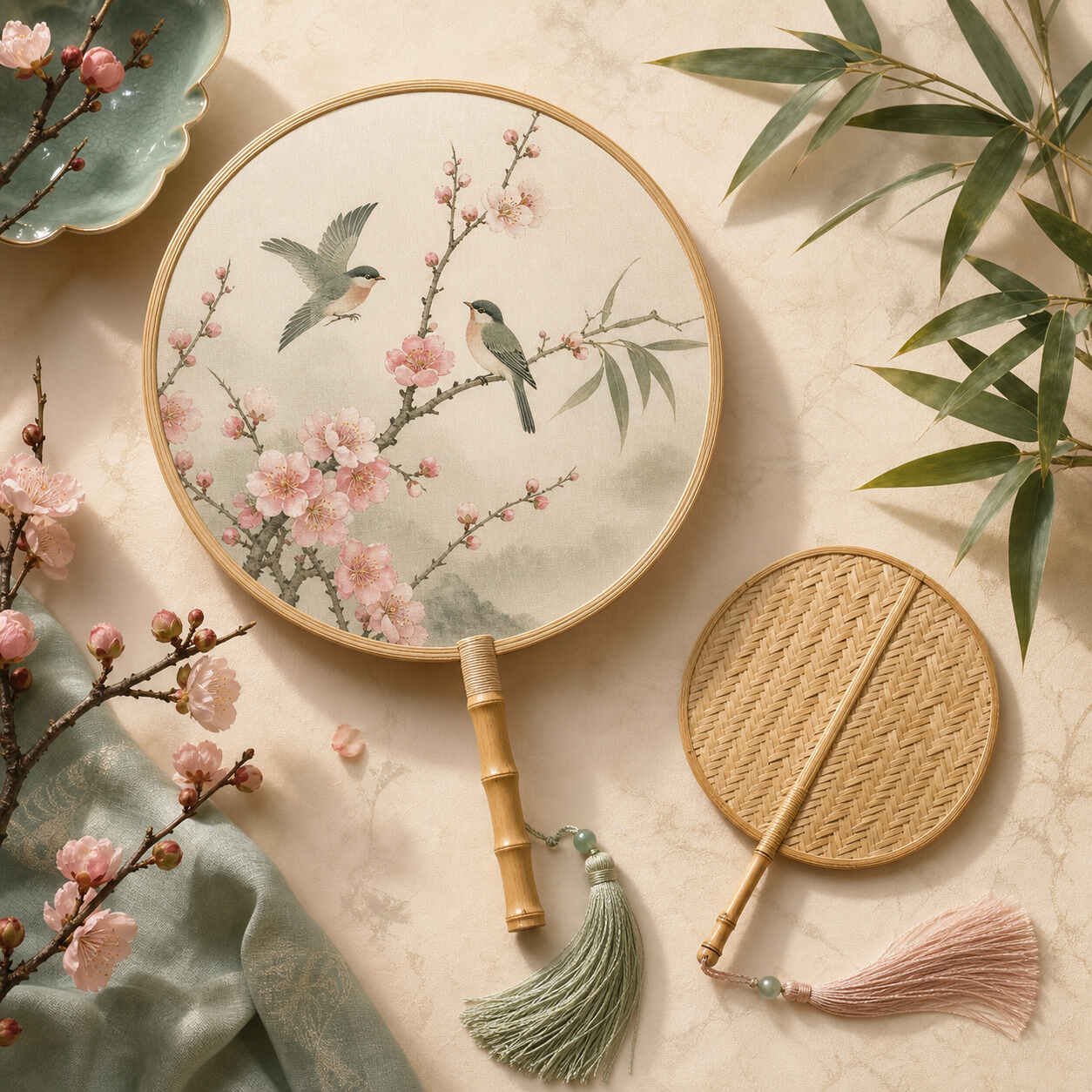
Bamboo Round Hand Fan
A bamboo round hand fan remains open rather than folding. It may be circular, oval, leaf-shaped, or gently rounded. It usually has a handle and may use a bamboo frame surrounding a silk, paper, fabric, or woven surface.
Round fans are elegant because of their continuous outline. Their surface is ideal for delicate painting, embroidery, floral designs, birds, calligraphy, or a simple plain color. They are often associated with graceful clothing, ceremonial settings, portrait photography, and traditional dance.
A round fan is less portable than a folding fan because it does not collapse. However, it can feel more stable and formal. Its shape can frame the face in photographs, create a soft silhouette beside flowing sleeves, or add balance to a carefully arranged outfit.
A bamboo round fan works especially well with hanfu because its stable form complements the flowing lines of traditional clothing. Pale bamboo, silk, and floral paintings often create a gentle, romantic effect. Dark bamboo and ink painting can produce a more serious, scholarly appearance.
Bamboo-Woven Fan
A bamboo-woven fan uses thin strips of bamboo to create the visible surface. The strips may be woven tightly, loosely, in a geometric pattern, or in a radial arrangement. The result is a fan with natural texture and a handmade feeling.
Woven bamboo fans often look less formal than painted silk fans, but they can be equally beautiful. Their appeal comes from the material itself: the warm color of bamboo, the rhythm of the weave, and the craftsmanship required to create an even surface.
These fans are popular for casual summer use, natural-style interiors, folk-inspired clothing, rustic weddings, craft collections, and gifts. They may be flat, oval, round, rectangular, or shaped with a gentle curve.
The weave affects airflow. A tightly woven fan may create a stronger breeze than an open weave. An open weave can feel airy and visually light, but it may allow more air to pass through rather than directing it toward the body.
Woven fans should be protected from crushing. A broken bamboo strip can be difficult to repair invisibly, so careful storage is essential.
Bamboo and Paper Fan
A bamboo-and-paper fan usually combines bamboo ribs with a paper leaf. This is one of the most accessible and familiar types of folding fan.
Paper provides a smooth surface for color, painting, printing, calligraphy, and pattern. It can be plain white, richly decorated, printed with traditional scenes, or designed in a modern style. The paper may imitate rice paper, handmade paper, parchment, or another artistic surface.
A bamboo-and-paper fan is often lightweight and easy to use. It can be a good choice for everyday cooling, costume styling, party favors, cultural events, stage props, and affordable gifts.
The main limitation is that paper is vulnerable to moisture, creasing, stains, and tears. If you want a fan for outdoor daily use, choose one with sturdy paper and solid rib construction. If you want a collector’s item, avoid exposing it to rain, humidity, food, or direct sunlight.
Bamboo and Silk Fan
A bamboo-and-silk fan combines bamboo structure with silk fabric. Silk has a soft luster that catches light differently from paper. It can make a fan appear more refined, delicate, and formal.
Silk may be painted, embroidered, dyed, printed, or left plain. A simple white silk fan with pale bamboo can look elegant and understated. A dark bamboo folding fan with hand-painted silk can feel dramatic and luxurious.
This type is often chosen for gifts, formal clothing, weddings, photography, dance, and home display. Silk fans may cost more than basic paper fans, especially when they involve hand painting or embroidery.
Silk requires gentle care. It can stain easily, fade in sunlight, snag on jewelry, and react poorly to moisture. If you plan to use a silk fan frequently, handle it with clean, dry hands and store it in a pouch or protective box.
Decorative Hanfu Fan
A decorative hanfu fan is selected primarily for its role as an accessory. It may be a folding fan, round fan, woven fan, silk fan, or another type. The key question is not simply whether it cools effectively, but whether it complements the outfit.
For a soft, romantic hanfu look, a round silk fan with flowers, butterflies, or pale colors may be suitable. For a scholar-inspired style, a folding fan with calligraphy, ink landscapes, or dark bamboo guards can work well. For a rustic or folk-style outfit, woven bamboo may add an appealing natural texture.
A fan can also affect posture and movement. Holding a fan encourages deliberate gestures. It can be raised near the face, held low at the waist, placed against the shoulder, or opened across the body. These poses can change the mood of a photograph or performance.
When choosing a hanfu fan, consider color, scale, material, and visual balance. A highly decorated fan may compete with a heavily embroidered outfit. A plain fan may be a better choice when clothing already has many layers, jewelry, or bold patterns.
Bamboo Fan Materials and Craftsmanship
The visible artwork on a fan may attract attention first, but craftsmanship determines whether the fan will remain beautiful after regular use.
Bamboo Ribs and Outer Guards
The ribs are the inner supports of a folding fan. They are usually thin and repeated across the fan leaf. The outer guards are thicker pieces on the left and right sides when the fan is closed.
Good bamboo ribs should be smooth, evenly cut, and free from splinters. They should not have sharp corners that can catch fabric or scratch the hand. When the fan opens, the ribs should form a balanced arc rather than leaning or bunching unevenly.
The guards may be plain or decorative. They can be carved with flowers, geometric patterns, bamboo leaves, dragons, clouds, or calligraphy. In higher-quality fans, the guards may be shaped carefully to feel comfortable in the hand.
The bottom pivot holds the ribs together. It may use a pin, rivet, or other fastening system. The pivot should be secure and aligned. If it is too loose, the fan may wobble or collapse. If it is too tight, opening the fan may place unnecessary strain on the paper or silk leaf.
Paper, Silk, and Fabric Fan Leaves
The fan leaf is the visible surface that spreads across the ribs. It determines much of the fan’s appearance and cooling ability.
Paper leaves are crisp, light, and ideal for painting or printing. They may show landscapes, birds, flowers, historical figures, traditional patterns, or simple color fields. Paper is often the most practical choice for a light and affordable fan.
Silk leaves are softer and more luminous. They can look especially beautiful in photographs and formal settings. Silk also works well for fine painting and embroidery, though it requires more careful handling.
Fabric leaves may use cotton, linen, synthetic fibers, or blended materials. Their quality varies widely. Some are durable and practical, while others are heavy or less responsive when folding.
A well-made fan leaf should attach cleanly to the ribs. The folds should align naturally. There should be no large bubbles, loose edges, excessive glue, or obvious wrinkling. Handmade fans may show small variations, but these should look intentional rather than careless.
Woven Bamboo Surfaces
Woven bamboo demands a different kind of skill. The maker must split bamboo into fine strips, prepare them to a consistent thickness, and weave them into a stable pattern. The surface should feel secure and even.
Examine a woven bamboo fan closely. Look for loose ends, broken strips, rough fibers, or uneven tension. A high-quality woven surface should have a coherent pattern, clean edges, and a secure connection to the frame or handle.
Woven fans can range from very simple to highly detailed. Some use only natural bamboo tones. Others use dyed strips to create flowers, waves, geometric borders, or symbolic patterns. The more intricate the pattern, the more important it is to check that the weaving remains firm and undamaged.
Painting, Calligraphy, and Decorative Motifs
A Chinese bamboo fan often serves as a small canvas. The surface may carry a landscape, a branch of plum blossoms, peonies, bamboo leaves, birds, fish, lotus flowers, mountains, rivers, or poetic text.
Landscape painting is especially popular because the open arc of a folding fan resembles a wide view. A river can curve through the folds. Mountains can rise across the leaf. A distant pavilion can sit near one edge, encouraging the eye to travel across the image.
Flower motifs can carry different associations. Plum blossoms are often connected with resilience and the return of spring. Peonies may suggest prosperity and beauty. Lotus flowers can represent purity and renewal. Bamboo imagery can suggest flexibility and integrity.
Calligraphy may include a poem, a phrase, a personal dedication, or one meaningful character. If you are buying a fan with Chinese writing, check the translation. Not every commercially produced fan uses meaningful or accurate text. A fan with a clear, well-chosen phrase can make a more thoughtful gift or personal item.
Uses of Chinese Bamboo Fans
Chinese bamboo fans are useful in many settings. Their flexibility is part of their enduring appeal.
Everyday Cooling
The most obvious use of a fan is to create airflow. A broad paper or silk folding fan can move a surprising amount of air. The larger the usable surface, the more air the fan can generally direct toward the body.
For daily cooling, choose a fan that is sturdy, light, and easy to operate. A fan that looks beautiful but is difficult to open may remain in a drawer. A modest bamboo-and-paper folding fan may be a better everyday companion than a delicate hand-painted silk piece.
A woven bamboo fan can also be pleasant in warm weather. It may create a softer breeze, particularly if the weave is open. Many people enjoy its natural texture and quiet, simple appearance.
Hanfu and Traditional Clothing
Fans are widely used with hanfu because they add shape and visual rhythm. They can coordinate with clothing colors, echo embroidery motifs, or create a contrast with flowing fabric.
A fan can also make an outfit feel more complete without requiring heavy jewelry or complicated accessories. It is portable, practical, and easy to incorporate into photographs.
For a formal hanfu event, a silk round fan may create elegance. For a literary or scholarly look, a folding fan with ink painting or calligraphy may be a better fit. For a casual outing, a simple woven bamboo fan can feel relaxed and natural.
Dance and Stage Performance
In dance, a fan becomes an extension of the arm. It can open suddenly, flutter rapidly, sweep through the air, hide the face, reveal an expression, or create a visual line across a group of performers.
For stage use, durability is essential. The fan should open reliably and withstand repeated movement. A delicate collector’s fan may not survive rehearsal, travel, and performance conditions.
Large fans produce stronger visual impact from a distance. Bright colors, contrasting patterns, and bold shapes may be easier for an audience to see. Smaller, detailed fans are more suitable for close-up settings, intimate performances, and photography.
Weddings and Ceremonies
Chinese bamboo fans can appear in weddings as bridal accessories, bridesmaid gifts, guest favors, decorative pieces, or photography props. They work especially well for summer outdoor events because they are both attractive and functional.
A couple might select fans in colors that match the wedding palette. Names, dates, floral patterns, or short messages can be printed on simple fans. Round fans can create a romantic visual effect, while folding fans can be convenient for guests.
For ceremonial use, think about durability. If dozens of guests will receive the fans, choose a design that can be handled without tearing or loosening immediately. If the fan is only for a formal portrait, a more delicate option may be appropriate.
Home Decoration
A Chinese bamboo fan can make an attractive decorative object. Large folding fans are often displayed fully open on walls. Round fans can be grouped in sets. Woven bamboo fans add texture to rooms with natural materials, wooden furniture, ceramics, linen, plants, or neutral colors.
When displaying a fan, protect it from direct sun. Strong sunlight can fade paper, silk, dye, and ink. Avoid damp spaces and areas near steam, grease, or heat. A fan should be displayed where it can be admired without being bumped, bent, or covered in dust.
Gifts and Personal Keepsakes
A fan can be a memorable gift because it feels useful and artistic at the same time. It is also easy to personalize through color, artwork, calligraphy, or a meaningful motif.
For a practical gift, choose a durable folding fan. For an art lover, choose one with painting or calligraphy. For someone who enjoys traditional clothing, select a fan that matches their preferred color palette. For a home decorator, choose a woven or painted fan designed for display.
A meaningful fan does not have to be expensive. The most important consideration is whether its design and use suit the recipient.
Chinese Bamboo Fan vs. Paper Fan vs. Japanese Folding Fan
These terms are often used loosely, but they describe overlapping rather than identical categories.
A bamboo fan refers to the use of bamboo in the structure or surface. A paper fan refers to paper being used for the leaf or visible surface. Many folding fans are both bamboo fans and paper fans because they have bamboo ribs and paper leaves.
A woven bamboo fan differs from a typical paper fan because bamboo itself creates the visible fan surface. It may feel more textured, more natural, and more durable in some ways, though it can be vulnerable to crushing and humidity.
A Japanese folding fan and a Chinese folding fan may share basic materials such as bamboo, paper, silk, and wood. Both may fold, open into a semicircle, and display painted or printed designs. However, they belong to distinct cultural traditions with different histories, artistic conventions, construction details, and uses.
It is not accurate to identify a fan’s origin solely because it has bamboo ribs or because it folds. The most reliable clues are maker information, documented provenance, artwork, construction, labels, and cultural context.
If a seller describes a fan as Chinese, look for supporting details rather than relying only on decorative motifs. Genuine cultural appreciation begins with careful description and avoids treating all Asian fans as interchangeable.
How to Choose a Chinese Bamboo Fan
Choosing a fan is easier when you begin with its intended use.
Choose by Purpose
For everyday cooling, choose a durable folding fan with a broad enough surface to move air effectively. Bamboo-and-paper fans are often practical and lightweight.
For formal outfits and photography, consider a silk round fan, a hand-painted folding fan, or a fan with a design that complements the clothing.
For dance, choose a fan that opens consistently, feels balanced, and can withstand frequent handling.
For home decoration, focus on artwork, size, color, and how the fan will fit into the room.
For travel, choose a compact folding fan and consider a pouch or slim protective case.
Consider Size
A small fan is easy to carry but may produce a limited breeze. A larger fan creates more airflow and visual impact but can be difficult to store in a handbag.
Check the folded length and open width before purchasing. For a stage fan or wall fan, open dimensions may matter most. For a daily fan, folded dimensions may matter more.
Round fans are typically less compact but can be more visually dramatic. They work well when portability is less important than appearance.
Check Bamboo Quality
Run your fingers gently along the ribs, guards, handle, and edges. Bamboo should feel smooth. Avoid obvious splinters, cracks, rough fibers, severe warping, or sticky finishes.
Natural color variation is normal. In fact, it is often attractive. What matters is whether the bamboo appears dry, stable, and properly finished.
If possible, open and close the fan several times. The movement should feel controlled. The ribs should not grind, twist, or catch. The fan should close neatly.
Evaluate the Fan Leaf
The paper, silk, or fabric surface should be securely attached. Look for loose edges, bubbling, tears, stains, uneven folds, or visible excess glue.
If buying online, look closely at detailed product photographs. Ask about materials, folded size, open size, number of ribs, and whether the artwork is printed or hand-painted. These details can help you understand what you are buying.
Consider Artwork and Meaning
Choose artwork that you genuinely enjoy. A fan may feature flowers, birds, landscapes, bamboo, calligraphy, clouds, fish, or abstract designs. Do not choose a design only because it seems traditionally Chinese; choose one that feels meaningful, balanced, and suited to your own taste.
If the fan includes Chinese characters, verify the translation. A beautiful-looking phrase may have a meaning that does not fit the intended occasion, or it may be inaccurate if copied carelessly.
Test Balance and Comfort
Hold the fan by its handle, guard, or pivot. Does it feel balanced? Is the handle comfortable? Is it too thick, too thin, too heavy, or too top-heavy?
For a long event, comfort can matter more than decorative detail. A fan that looks perfect in a product photo may feel awkward after twenty minutes of use.
Handmade Fans and Mass-Produced Fans
Both handmade and mass-produced Chinese bamboo fans have a place. The choice depends on your expectations, budget, and intended use.
A mass-produced fan may be affordable, consistent, and suitable for everyday use, weddings, party favors, or large events. It may use printed designs, machine-cut bamboo, standardized ribs, and synthetic materials. This does not automatically make it poor quality. A well-made mass-produced fan can be useful and attractive.
A handmade fan may show more individual variation. The bamboo may be shaped and polished by hand. The artwork may be painted individually. The weaving may be more intricate. The calligraphy may be original. These details can give the fan a stronger sense of craftsmanship and uniqueness.
However, handmade does not always mean flawless. Small irregularities can be part of the object’s character. The important question is whether the construction is sound and whether the variation reflects handwork rather than carelessness.
When buying a handmade fan, ask about the maker, materials, process, and care requirements. A maker who can clearly explain the work is more likely to provide useful information about the object.
How to Care for a Chinese Bamboo Fan
Careful handling can greatly extend the life of a bamboo fan.
Open and Close Carefully
Do not force a folding fan open if the leaf catches between the ribs. Gently realign the folds first. Opening a fan too forcefully can tear paper, stress silk, loosen the pivot, or crack thin bamboo ribs.
Close the fan slowly when possible. Make sure the leaf folds naturally rather than becoming trapped or creased in the wrong direction.
Keep It Dry
Water is one of the greatest risks to a fan. Moisture can stain paper, loosen adhesives, warp bamboo, distort silk, and encourage mold in humid conditions.
If the fan becomes slightly damp, allow it to air-dry in a shaded, ventilated space. Do not place it directly on a radiator, near a heater, or under intense sunlight. Rapid drying can create uneven tension in natural materials.
Avoid Direct Sunlight
Sunlight can fade inks, dyes, silk, paper, and painted details. It can also dry bamboo unevenly over time. If you display a fan on a wall, choose a location that does not receive prolonged direct light.
Clean Gently
Use a soft, dry cloth for bamboo guards, ribs, handles, and frames. Do not soak the fan or apply harsh cleaning chemicals. Avoid oils, furniture polish, alcohol, and abrasive cleaners unless a qualified specialist specifically recommends a treatment.
For a paper or silk leaf, use a soft brush to remove loose dust. Do not rub painted surfaces aggressively. If the fan is valuable or antique, consult a professional conservator before attempting any cleaning.
Store Properly
Store folding fans closed in a dry, clean place. A soft fabric pouch can protect the fan during travel. A rigid box can offer more protection for valuable pieces.
Store round fans where they will not be bent or crushed. Keep woven bamboo fans away from pressure, moisture, and extreme temperature changes.
Do not leave a fan in a hot car, a damp bathroom, a crowded bag, or a place where heavy objects may fall on it.
Repair With Care
If a fan develops a tear or a broken rib, avoid using ordinary household tape. Tape can discolor paper, create sticky residue, and make later professional repair more difficult.
For inexpensive everyday fans, replacement may be the simplest option. For hand-painted, sentimental, antique, or high-value fans, seek advice from a specialist in paper, textile, decorative arts, or bamboo conservation.
The Lasting Appeal of the Chinese Bamboo Fan
A Chinese bamboo fan remains meaningful because it combines so many qualities in one object. It is useful but elegant. It is light enough to carry but complex enough to involve careful construction. It can be simple, colorful, formal, rustic, artistic, or playful.
A fan also changes through use. Closed, it appears narrow and quiet. Open, it becomes a broad visual surface. Held in the hand, it can be practical. Hung on a wall, it becomes decorative. Paired with clothing, it becomes an accessory. Covered in painting or calligraphy, it becomes a small portable artwork.
The best fan is not necessarily the largest, most expensive, or most decorated. It is the fan that fits its purpose, feels comfortable in the hand, is made with reasonable care, and gives you pleasure each time you use it.
FAQ
Are bamboo fans Chinese or Japanese?
Bamboo fans can be found in both Chinese and Japanese traditions. Bamboo is widely used for fan ribs, frames, handles, and woven surfaces because it is lightweight, strong, and flexible. The material alone does not determine a fan’s cultural origin.
To understand whether a fan is Chinese or Japanese, consider its construction, shape, artwork, maker information, provenance, and historical context. Chinese and Japanese fan traditions have influenced one another at various points, but they also have distinct forms and artistic conventions.
What are Chinese fans called?
The general Chinese word for a fan is shàn (扇). More specific names may describe its form or material, such as a folding fan, round fan, bamboo fan, hand fan, or palm fan.
The name used in English often depends on what aspect of the fan is being emphasized. For example, “Chinese bamboo folding fan” highlights the cultural context, material, and structure.
Are bamboo fans good?
Yes. Bamboo fans can be lightweight, attractive, and practical. Folding fans with bamboo ribs and paper or silk leaves usually provide stronger airflow, while woven bamboo fans offer natural texture and gentler airflow. Their quality depends on smooth bamboo, secure construction, and careful handling.
Are Chinese fans good luck charms?
Chinese fans can have auspicious meanings, particularly when their shape or artwork is associated with harmony, prosperity, reunion, beauty, or good wishes. Round fans are often linked with union and happiness, while flowers, bamboo, calligraphy, and other motifs can add symbolic meaning.
What are the best Chinese fan brands?
The best Chinese fan brand depends on your purpose. Look for sellers or artisans that provide clear information about materials, dimensions, craftsmanship, artwork, and care. For daily use, choose a sturdy bamboo folding fan; for collecting or gifting, consider handmade, painted, silk, calligraphy, or woven bamboo designs.
Are bamboo fans good for cooling?
Yes. Bamboo fans can be effective for cooling, especially if they use a broad paper or silk leaf supported by bamboo ribs. A larger fan usually moves more air than a smaller one.
Woven bamboo fans can also create a pleasant breeze, although an open weave may let some air pass through. Their cooling effect is often softer than that of a solid paper fan.
Are bamboo folding fans durable?
A well-made bamboo folding fan can be durable when handled properly. Bamboo ribs are strong for their weight, but thin ribs can crack if the fan is forced, dropped, sat on, or stored under heavy objects.
The fan leaf may be more fragile than the bamboo structure. Paper can tear or wrinkle, while silk can stain or snag. Proper storage and gentle use are important.
What is the difference between a bamboo fan and a paper fan?
A bamboo fan uses bamboo in its ribs, frame, handle, guards, woven surface, or other structural parts. A paper fan uses paper as the fan leaf or visible surface.
Many folding fans are both bamboo fans and paper fans because bamboo ribs support a paper leaf. A woven bamboo fan is more distinct because bamboo forms much of the visible surface itself.
Can I use a Chinese bamboo fan with hanfu?
Yes. Chinese bamboo fans are popular hanfu accessories. Folding fans, round fans, silk fans, and woven bamboo fans can all work well, depending on the outfit and occasion.
Choose a fan that complements the clothing rather than competing with it. Soft floral fans often suit romantic or elegant outfits, while ink-painted folding fans can work well with scholarly, historical, or minimalist styles.
How do I choose the right size bamboo fan?
Choose based on intended use. A compact folding fan is better for travel and everyday carrying. A larger fan is better for stronger airflow, stage use, wall display, or dramatic photography.
Check both folded and open dimensions. A fan may look small when closed but become quite wide when opened.
How should I store a Chinese bamboo fan?
Store a folding fan closed in a dry, shaded place. Use a pouch or protective case for travel. Store round fans flat or upright with enough support to prevent bending.
Keep all fans away from moisture, strong sunlight, high heat, food spills, cosmetics, perfume, and heavy objects.
How does a Chinese fan work?
A Chinese fan creates airflow when it is waved. This helps move warm air away from the skin and supports sweat evaporation, creating a cooling sensation. In a folding fan, bamboo ribs rotate around a bottom pivot to open the paper, silk, or fabric leaf into a broad semicircle.
Can Chinese bamboo fans be used as wall decorations?
Yes. Large folding fans, painted fans, round fans, and woven bamboo fans can all be displayed on walls. Make sure the display area is dry and protected from direct sunlight.
A fan can be displayed alone as a focal point or grouped with other fans, textiles, ceramics, framed art, or natural materials.
Are Chinese bamboo fans good gifts?
They can be excellent gifts because they combine usefulness, craftsmanship, visual beauty, and cultural interest. A compact folding fan is practical for summer. A painted or calligraphy fan may suit an art lover. A woven bamboo fan may appeal to someone who likes natural materials and home decoration.
For the best result, choose a design that fits the recipient’s personal style and intended use.
How can I tell if a bamboo fan is well made?
Look for smooth bamboo, even ribs, secure joints, a stable pivot, neatly attached fan leaves, and a clean opening-and-closing action. Avoid fans with obvious splinters, severe warping, cracked ribs, loose weaving, excess glue, or paper that catches during folding.
A good fan should feel balanced in the hand, open smoothly, close neatly, and look carefully finished.




Leave A Comment