
A bamboo tea box gives your tea collection a dedicated home. Instead of keeping half-empty cartons scattered across cupboards, drawers, and countertops, you can arrange your favorite tea bags in one place and see what is available before putting the kettle on. For a household that enjoys several varieties, this simple change can make the everyday tea routine feel more organized and welcoming.
The right box does more than look attractive. Its compartments should fit your tea packets, its lid should open comfortably, and its overall size should suit the space where you plan to use it. A compact box might be perfect for a small apartment, while a larger organizer could suit a family kitchen, shared office, or guest refreshment station.
Bamboo tea boxes also come in different configurations. The examples in the supplied product screenshot include divided interiors, solid bamboo lids, transparent lids, and products described with six or eight compartments. These details offer a useful starting point, but choosing well means looking beyond the product photograph and considering how the box will work with your actual tea collection.
This guide explains how to choose a bamboo tea box, evaluate its practical features, organize different tea varieties, and care for the box without confusing decorative storage with airtight tea preservation.
What Is a Bamboo Tea Box?
A bamboo tea box is a storage container designed to organize tea bags, individually wrapped tea sachets, or suitably packaged tea accessories. Most familiar designs have a rectangular body, a hinged lid, and an interior divided into smaller compartments. These sections help keep different varieties separate so that you can find the tea you want without searching through several original cartons.
Think of the box as an organizer and serving accessory. It brings order to a collection and makes the contents easier to browse. When you open it for yourself or a guest, the available choices are presented together rather than hidden behind unrelated kitchen supplies.
However, a bamboo tea box is not automatically an airtight container. A lid can cover the contents without forming a moisture-resistant or odor-resistant seal. That distinction matters when deciding whether to store wrapped tea bags, unwrapped tea bags, or loose leaves inside it.
Tea Organization Versus Tea Preservation
Organization concerns accessibility: where each tea belongs, how easily you can identify it, and whether the box fits your routine. Preservation concerns exposure to air, light, moisture, heat, and surrounding odors.
For many everyday teas, protective packaging remains important even when the packets are placed inside a decorative organizer. Tea storage guidance identifies these environmental factors as significant concerns, so a bamboo exterior should not be treated as a substitute for suitable sealed packaging.senbirdtea+1
A useful approach is to let the bamboo box organize your collection while the individual wrappers, sealed pouches, or appropriate inner containers provide the necessary protection.
Why Choose a Bamboo Tea Box?
A bamboo tea box can be appealing because it combines a visible storage solution with a simple, natural-looking presentation. Its usefulness, however, depends on whether it solves an actual problem in your home. If your tea collection already fits neatly inside one carton, a large divided box may add unnecessary bulk. If you regularly choose between several varieties, the same box may make the routine much easier.
Before purchasing, identify what you want to improve. Perhaps you need to clear a crowded cupboard, create a welcoming tea station, or stop buying duplicates because you cannot see what you already own. These are practical goals that help you choose the right design.
Bringing Several Tea Varieties Together
A divided box allows you to group different tea packets without mixing them into one loose pile. You might assign separate sections to breakfast tea, green tea, mint infusions, fruit blends, and decaffeinated options.
This arrangement also makes replenishment more straightforward. When one compartment becomes empty, you know which variety needs attention. You do not have to inspect every carton to understand what remains.
Making Tea Selection More Welcoming
For guests, an open tea box creates a clear invitation to choose. They can browse the available packets and select a familiar favorite or something different.
The presentation works best when labels remain visible and the compartments are not overfilled. An attractive box should make choosing simpler, not require guests to pull out several packets just to identify a blend.
Start With Your Tea Collection, Not the Product Photograph
The most useful starting point is the tea you already buy. Product photographs often show carefully arranged packets of similar dimensions, but an everyday collection may include tall envelopes, wide wrappers, compact paper sachets, and unusually shaped packaging.
Gather a few examples before comparing boxes. Include your largest packet, your most frequently used tea, and any variety with packaging that differs noticeably from the rest. This small preparation helps you avoid choosing a box that looks spacious but cannot accommodate your preferred products.
Count Varieties and Typical Quantities
Write down how many varieties you normally keep open at once. Then estimate how many packets of each variety you want available in the organizer.
A household with four regular favorites may need fewer compartments than someone who enjoys a rotating selection of twelve teas. However, the household may need more space within each compartment if one favorite is consumed frequently.
Separate the number of varieties from the number of packets. They answer different questions: compartments determine how many categories you can organize, while usable interior space determines how much each category can hold.
Decide What Belongs Outside the Box
You do not need to fit your entire tea supply into one organizer. A bamboo tea box can hold a convenient working selection, while unopened cartons and refill stock remain elsewhere.
This approach keeps the box easier to browse. It also reduces the temptation to compress packets into tight rows simply because you have more stock available.
Choosing Between Six, Eight, and Twelve Compartments
Compartment count is one of the most visible differences between bamboo tea boxes. Six- and eight-compartment designs appear among the examples in the supplied screenshot, while the accompanying document also proposes comparing different compartment arrangements as part of a practical buying guide.
Nevertheless, more compartments do not automatically mean a better organizer. A larger number of divisions can create more categories, but it may also reduce the width of each section if the overall box dimensions stay similar.
When Six Compartments May Be Enough
A six-compartment box is worth considering when your collection is focused. You could use four compartments for everyday teas, one for an occasional alternative, and one for a caffeine-free infusion.
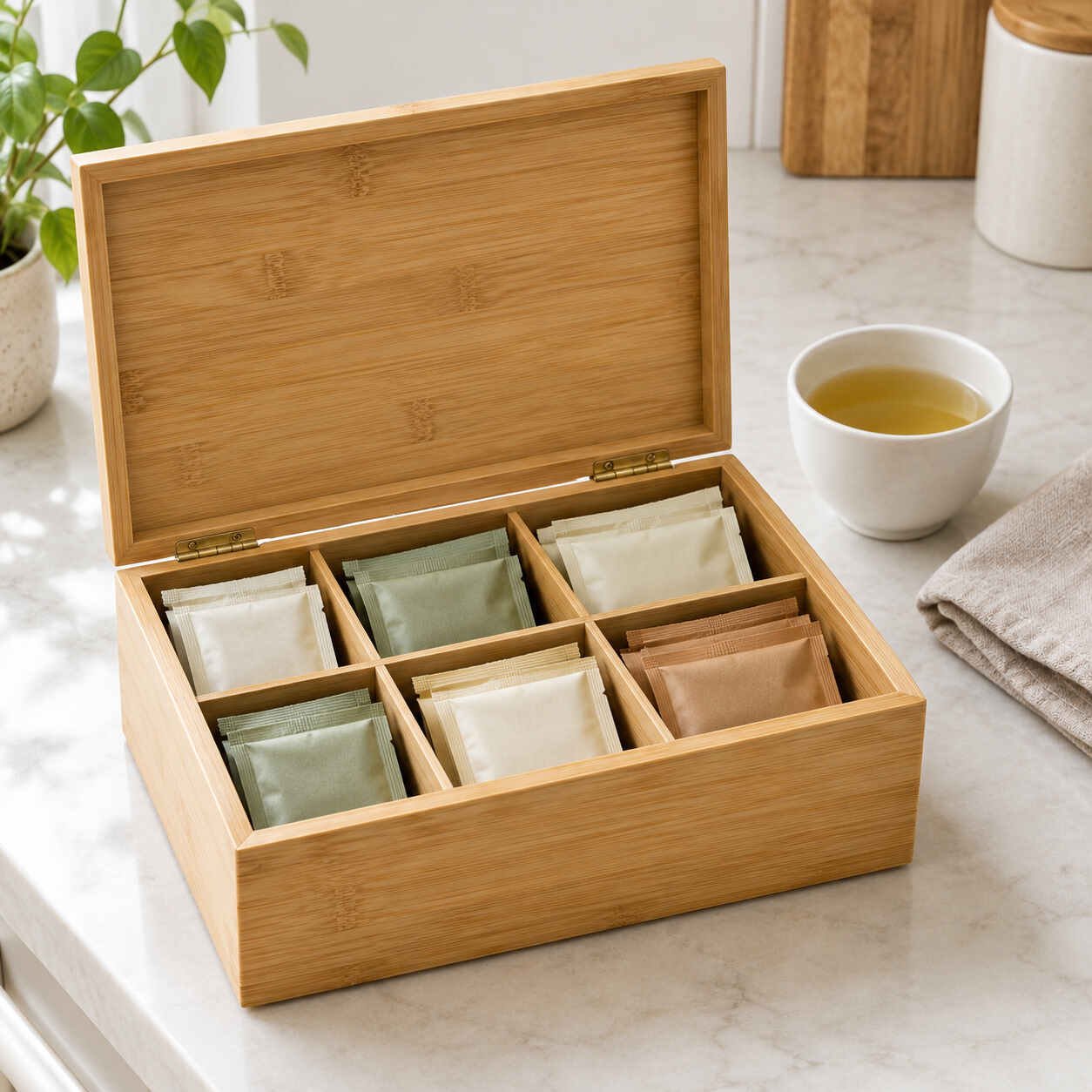
The important question is whether each section comfortably holds the packets you want to store. Six generous compartments may be more useful than eight narrow ones, especially if your favorite tea comes in wide wrappers.
When Eight Compartments Offer More Flexibility
An eight-compartment design can make it easier to separate additional varieties without combining unrelated packets.
For example, you might keep breakfast tea and another black tea apart, give two green teas their own sections, and reserve the remaining compartments for infusions and decaffeinated choices. The arrangement should reflect your habits rather than a fixed formula.
When Should You Choose a Large Bamboo Tea Box?
A large bamboo tea box makes sense when you keep many tea varieties, share your collection with several people, or want to present a broader selection to guests. Extra space can help you give popular teas their own compartments and keep less frequently used options separate.
However, “large” should describe useful capacity, not just external dimensions. A box with a wide footprint may still contain narrow compartments that do not accommodate your preferred packets. Check the internal width, depth, and closed-lid clearance before deciding that a larger model will solve your storage needs.
Also measure the place where the box will sit. Leave enough room to open the lid, reach the back compartments, and use nearby mugs or appliances without moving the organizer each time.
If your collection is small, a large bamboo tea box may add unnecessary bulk. A smaller box holding a convenient working selection, with refill stock stored separately, can be easier to manage. Choose extra capacity because your routine needs it, not simply because a bigger box appears more impressive.
Measuring a Bamboo Tea Box Correctly
External measurements tell you whether a box will fit on a shelf or countertop. Internal measurements tell you whether it will hold your tea. Both are necessary, and one cannot reliably substitute for the other.
A product listing may provide only the overall length, width, and height. Those figures include the walls, base, lid, and dividers. They therefore do not describe the full usable space available inside each compartment.
Check the Footprint and Opening Space
Measure the intended location before ordering. Include the area behind and above the box, not just the surface underneath it.
A hinged lid needs room to move. A box that fits beneath a shelf when closed may be awkward to use if the lid cannot open fully. Likewise, a deep box positioned against a backsplash may require you to pull it forward whenever you want tea.
Consider whether that movement would become irritating during everyday use.
Ask for Usable Compartment Dimensions
For packet storage, request the internal width, depth, and effective closed-lid height of a compartment.
Measure your largest tea wrapper and compare it with those figures. Allow some room for fingers to grasp the packet and for slightly different packaging.
Avoid selecting a box based on an exact, tight match. A packet that technically fits may still be difficult to remove, particularly when the compartment is full. Practical clearance is part of useful capacity.
Understanding Tea Bag Capacity Claims
A statement such as “holds 100 tea bags” sounds precise, but it is incomplete unless the seller explains what kind of tea bags were used and how they were arranged.
Tea packets differ in width, thickness, height, and stiffness. A thin wrapper can occupy much less space than a bulky individually packaged sachet. The number of packets that fit also changes depending on whether they stand upright, lie flat, or sit in overlapping rows.
Look for a Clear Capacity Demonstration
A helpful demonstration shows the actual packets inside the box. Ideally, you can see whether the lid closes without pressing on them and whether the front row remains easy to remove.
If the photograph shows only a few packets, do not assume that an advertised maximum capacity would be equally convenient in daily use.
You want usable storage, not merely the largest number that can be squeezed into the interior.
Leave Space for Browsing
A comfortable arrangement gives you room to move packets aside and read labels. When every compartment is tightly packed, choosing one tea may disturb several others.
Start with modest quantities and refill as needed. If you discover that one variety consistently runs out first, give it an additional compartment or keep its refill carton nearby.
Capacity should support your routine. It does not need to become a target that you fill completely.
How to Choose a Bamboo Tea Box with Lid
A bamboo tea box with lid lets you cover the collection between uses while keeping the available choices together in one organizer. When comparing designs, consider not only how the lid looks but also how comfortably it opens, whether it stays in a convenient position, and how much space it needs above and behind the box.
A solid bamboo lid conceals mixed packaging and creates a quieter appearance when the box is closed. A transparent lid lets you see the selection and notice low stock without opening the organizer. Either option can work well when it suits your space and daily routine.
Check the clearance inside the closed box, particularly if you store tall tea wrappers upright. The lid should close without bending packets or pressing them tightly into the compartments.
Finally, remember that a bamboo tea box with lid is not automatically airtight. Unless the product has a documented sealing design, use the lid for covering and presentation while relying on suitable packaging or inner containers for the tea’s preservation needs.
The lid affects both appearance and everyday convenience. A solid bamboo lid presents a more enclosed surface, while a transparent panel allows you to view the selection without opening the box.
The supplied screenshot includes product descriptions mentioning transparent or acrylic lids, demonstrating that visibility is a recurring feature among these tea organizers.
Neither style is universally preferable. The better choice depends on where the box will sit, how often it will be opened, and whether you want the contents visible between uses.
Choosing a Solid Bamboo Lid
A solid lid may suit a kitchen where you prefer a quieter appearance. It conceals mixed packaging and makes the organizer look less busy when closed.
It also keeps direct light from entering through the top, although that does not establish that the complete box is airtight or suitable for unprotected loose tea.
If you rarely change your selection, opening the lid to check the contents may be a minor inconvenience.
Choosing a Transparent Lid
A transparent lid is useful when you want to identify varieties or notice low stock at a glance. It can make a guest tea station feel approachable because the available choices are immediately visible.
However, transparent sections require their own care. Ask whether the panel is glass or acrylic, and follow the appropriate cleaning instructions.
For freshness-sensitive tea, remember that a clear lid allows light through. Suitable packaging and sensible placement still matter.
Fixed Dividers or Removable Dividers?
Dividers create the structure of a bamboo tea box. Their design determines how easily you can separate varieties and whether you can adjust the interior when your collection changes.
Fixed dividers suit people who want a stable arrangement. Removable dividers may offer flexibility, but the quality of their fit matters. A loose divider that shifts whenever you remove a packet can be frustrating.
The Advantages of Fixed Compartments
With fixed dividers, every section has a consistent place and size. This makes it easy to establish a familiar system.
You can assign each compartment permanently and refill it without thinking about the layout. For a shared household, predictable placement helps other people return packets to the right section.
The limitation is that unusually wide packets or small tea tins may not fit. Check the dimensions before assuming that a fixed layout can accommodate them.
The Advantages of Adjustable Interiors
A removable divider can allow you to combine sections or create a larger area for a different type of packaging.
This may be useful if you change brands frequently or want part of the box to hold sealed sample pouches.
Before buying, ask how the dividers are secured, whether they can be removed without tools, and whether taking them out leaves a smooth, usable interior. Flexibility is valuable only when the adjusted layout remains practical.
Evaluating Construction and Everyday Usability
An attractive photograph cannot tell you everything about a bamboo tea box. Construction details become more noticeable after repeated opening, closing, refilling, and cleaning.
When examining a box in person, test it as you would use it at home. Open the lid, check the compartment edges, place a packet inside if permitted, and see how comfortably you can reach the back row.
For an online purchase, close-up photographs and specific answers are more useful than broad descriptions such as “premium quality.”
Check the Lid, Hinges, and Alignment
The lid should close without being forced. Look for a reasonably even fit and ask how it behaves when fully open.
A lid that stays upright can make browsing easier, but do not assume that every hinged design has this feature. Some may require support or have a limited opening angle.
Inspect hinge attachment points where possible. You want the hardware to feel secure rather than visibly loose.
Inspect the Interior Finish
Run your attention over the divider edges, corners, and base. The interior should not snag wrappers or make cleaning unnecessarily difficult.
Also consider how much finishing material is used and whether the manufacturer provides relevant care and intended-use information.
A strong or persistent smell is a reason to investigate before storing tea. Do not rely on the appearance of bamboo alone to judge the suitability of the complete product.
What “Bamboo” Does and Does Not Tell You
The word bamboo describes a material, but it does not fully describe the finished tea box. A product may also include hinges, adhesive, coatings, a transparent panel, feet, or other components.
This matters when comparing products. Two boxes described as bamboo may differ significantly in construction, finish, repairability, and cleaning requirements.
Ask About the Complete Product
Useful questions include:
-
Is the main body made from bamboo throughout?
-
What material forms the base?
-
Are the dividers fixed or removable?
-
Is the transparent panel glass or acrylic?
-
What finish is applied to the interior?
-
What cleaning method does the manufacturer recommend?
These details help you assess the box as a complete object rather than relying on one material name.
Be Specific About Environmental Preferences
If environmental considerations influence your purchase, look for information that supports the particular claim being made.
Ask about sourcing, packaging, construction, and whether damaged components can be replaced. Avoid assuming that every bamboo product has the same environmental profile.
A sensible practical goal is to choose a box that suits your needs and remains useful over time. An oversized organizer that you stop using quickly is not necessarily a better purchase than a modest, well-matched design.
How to Organize Your Bamboo Tea Box
The best organization system is one you can maintain without effort. A complicated arrangement may look impressive initially but become confusing when several people use the box.
Begin with the most common choices. Put frequently used tea where it is easiest to reach, then assign the remaining compartments to less frequent options.
Keep the original labels visible whenever possible. They provide more information than a generic category label alone.
Organize by Tea Variety
You might separate black teas, green teas, oolong teas, and herbal infusions. Within those broad groups, give your regular favorites their own compartments.
This system works well when people choose according to flavor or tea type.
If one category contains several different packets, arrange them consistently so the selection remains easy to browse.
Organize by Daily Routine
Another approach is to group tea according to when you drink it: morning favorites, afternoon alternatives, and evening choices.
Be careful not to assume a tea is caffeine-free simply because its packaging or name suggests relaxation. Read the product label and keep relevant information available.
Organize for Multiple People
In a shared household, you could reserve sections for individual favorites and use the remaining space for communal options.
The goal is not a perfectly symmetrical display. It is a layout that makes the right tea easy to find and encourages everyone to keep the box orderly.
What Is the Best Thing to Store Tea Bags In?
The best thing to store tea bags in depends on how they are packaged. Individually sealed tea bags can be arranged inside a bamboo tea box while remaining in their protective wrappers. This gives you an accessible selection without removing the packaging that helps protect the tea.
For unwrapped tea bags or products supplied in a shared resealable pouch, keeping them in suitable sealed packaging or an appropriate airtight container is a more useful starting point than placing them loose in an ordinary divided box. A bamboo tea box can still organize the surrounding collection, but a hinged lid alone should not be assumed to provide an airtight seal.
Think of the storage arrangement in two layers: the packaging or inner container protects the tea, while the bamboo organizer keeps your choices tidy and easy to find. Keep the box in a suitable location and avoid overcrowding the compartments, so that selecting one packet does not disturb the rest.
Individually wrapped tea bags are a straightforward match for a compartment organizer, but wrappers differ. Some are sealed protective envelopes; others are relatively simple paper covers.
The bamboo box adds organization, but it should not be assumed to compensate for packaging that provides limited protection.
Keep Protective Wrappers Intact
Do not remove wrappers merely to create a more uniform display. If the manufacturer supplies the tea in sealed individual packaging, keep that protection until you are ready to brew.
For products without individually protective wrappers, consider whether their original resealable container is the more appropriate storage choice.
Guidance from tea suppliers emphasizes protection from air, light, moisture, heat, and strong odors for many everyday teas. Those needs should guide the arrangement rather than appearance alone.senbirdtea+1
Rotate Small Working Quantities
Place older stock where it will be used first and refill with manageable quantities.
If your collection changes frequently, keep a simple note of purchase or opening dates on the original packaging. Avoid inventing one shelf-life rule for every tea.
Check the producer’s guidance and the condition of the packaging. The tea box is a convenient place to keep a working selection, not a reason to disregard product-specific storage instructions.
Can a Bamboo Tea Box Hold Loose-Leaf Tea?
A bamboo tea box can organize sealed loose-leaf tea pouches or suitably sized inner containers. However, that does not mean you should pour loose leaves directly into its compartments.
Direct storage introduces questions about sealing, finishes, odors, cleaning, and intended food contact. Unless the product is specifically designed and documented for that use, treating it as a secondary organizer is the more cautious approach.
Use Suitable Inner Packaging
Small sealed pouches or appropriate tea containers may fit inside a larger compartment arrangement. Measure them before buying because many tea boxes are designed around flat packets rather than tins.
For many ordinary loose-leaf teas, a suitable airtight container in a cool, dry location offers protection that a decorative hinged box may not provide. Tea types can have different storage needs, so follow the producer’s guidance rather than applying one rule indiscriminately.senbirdtea+1
Keep the Organizer’s Role Clear
The box can bring several containers together, keep labels visible, and simplify selection.
The inner packaging handles the preservation requirements. This division of roles allows you to enjoy the appearance of bamboo without assuming that an unsealed compartment can do everything a dedicated tea container does.
If the containers do not fit comfortably, keep them nearby instead of forcing them into a box intended for tea bags.
Where to Place a Bamboo Tea Box
Placement determines whether the organizer becomes a useful part of your routine or an object you constantly move out of the way.
Choose a location that is easy to reach but does not interfere with food preparation, cupboard doors, or other frequently used appliances.
On a Kitchen Counter
A counter can provide convenient access, but avoid placing the box immediately beside steam, splashes, or cooking activity.
Tea storage advice recommends avoiding heat, moisture, and strong surrounding odors. A location near the kettle may seem convenient, yet it should still be far enough away to avoid repeated steam exposure.senbirdtea
Leave space to open the lid and select a packet without moving mugs or utensils first.
Inside a Cupboard
A cupboard may offer a less visually busy arrangement and reduce light exposure.
Check shelf height carefully. If the lid cannot open comfortably, consider whether you will be happy removing the box each time.
On a Sideboard or Tea Station
A dedicated surface can work well when tea is served away from the kitchen.
Keep the arrangement restrained: the box, a few mugs, and essential accessories may be enough. An overcrowded display can make the tea box harder to use even if the overall presentation looks decorative.
Using a Bamboo Tea Box in Shared Settings
A bamboo tea box can serve as a practical organizer in an office, guest room, meeting space, or shared refreshment area. In these settings, clarity matters because users may not know the arrangement.
The box should help people make a choice independently. Visible labels and a consistent layout are more useful than a tightly packed assortment.
Keep Product Information Available
Retain original wrappers so users can read the tea name and any relevant preparation or ingredient information.
Where additional labeling is helpful, use accurate descriptions taken from the product packaging. Avoid unsupported statements about health effects or suitability for particular dietary needs.
Refill and Inspect Regularly
Assign someone to check the selection, remove empty wrappers, and replenish popular varieties.
Do not mix loose, unidentified packets into established compartments simply to fill gaps. A slightly emptier box with clear choices is preferable to a full box that creates uncertainty.
Plan for Easy Handling
Position the box where users can open it without reaching across a hot appliance or disturbing other items.
For frequent service, consider how easily the lid operates and whether the interior can be inspected and cleaned. A shared tea box should be chosen for dependable access, not only for its appearance on the first day.
Cleaning and Caring for a Bamboo Tea Box
Care should begin with the manufacturer’s instructions because finishes, adhesives, panels, and hardware can differ between products.
General bamboo care guidance advises against soaking and dishwasher cleaning. It also emphasizes drying and storage in a dry environment. These principles are relevant when assessing how to maintain a bamboo organizer, although the instructions for your particular box remain the priority.totallybamboo+1
A Gentle Cleaning Routine
Remove the tea packets before cleaning. Use a soft, dry cloth to collect crumbs and dust from accessible surfaces.
If the manufacturer permits damp wiping, use a lightly dampened cloth and an appropriate mild cleaning solution. Avoid saturating joints, corners, or the base.
Wipe away moisture and leave the box open until it is completely dry before returning the tea.
Care for Transparent Panels Separately
Follow the specified cleaning method for glass or acrylic. Avoid assuming that a product intended for one panel material is appropriate for another.
Keep cleaning liquid away from hinges and surrounding bamboo wherever possible.
Do Not Apply Treatments Automatically
A decorative tea box does not necessarily need the same treatment as a cutting board.
Do not apply oils, waxes, fragrances, or other products unless the manufacturer recommends them for that finish and use. The aim is a clean, dry, suitable interior, not a heavily scented or unnecessarily treated surface.
What Is a Good Gift for Someone Who Loves Tea?
A good gift for someone who loves tea is something that suits the way they already enjoy it. A bamboo tea box paired with a small selection of sealed teas can be a thoughtful choice for someone who likes browsing several tea bag varieties. It combines a practical organizer with a personal selection of flavors.
Before choosing the box, consider the recipient’s collection and available space. A compact organizer may suit someone with a few everyday favorites, while a larger divided box may work better for a person who regularly offers different teas to guests. If they mainly drink loose-leaf tea, check whether their sealed pouches or preferred containers would fit, rather than assuming a tea bag organizer will meet their needs.
For a more personal gift, choose teas they already enjoy, leave the original labels and packaging intact, and add a short handwritten note. An engraved lid can also be considered, provided the personalization does not interfere with the box’s everyday use.
A tea box can make a thoughtful gift when it reflects the recipient’s actual habits. The most suitable choice may be a modest organizer that fits their kitchen rather than the largest or most elaborate model.
Consider how they drink tea. Someone who enjoys individually wrapped tea bags may appreciate divided compartments. A person who mainly buys large loose-leaf pouches may prefer dedicated tea containers instead.
Match the Size to the Recipient
Think about available space and the number of varieties they regularly keep.
A compact box can be easier to accommodate in a small home, while a broader selection may suit someone who frequently serves guests.
If you do not know their preferred brands, avoid relying on one packet size when choosing narrow compartments.
Create a Useful Gift Set
You can pair the box with a small selection of sealed teas. Keep the original product information and avoid opening packaging simply to improve the arrangement.
Choose fewer, clearly identified options rather than filling every section with an unfamiliar assortment.
Consider Personalization Carefully
An engraved name or short message may add meaning, but confirm its placement and appearance before ordering.
Personalization should not interfere with opening the lid, cleaning the surface, or using the box comfortably. Practical suitability remains more important than decorative detail.
What Is the Best Tea Box?
The best tea box is the one that fits your tea collection, protects the packaging you use, and makes everyday selection easy. There is no single design that works equally well for every tea drinker. Someone who keeps a few individually wrapped favorites may prefer a compact divided organizer, while a household with a broad selection may need a larger box with more generous compartments.
For organizing wrapped tea bags, a bamboo tea box is worth considering when its sections fit your packets comfortably and its lid opens easily in the intended location. For tea that requires airtight storage, suitable sealed packaging or dedicated inner containers remain important. An attractive outer box should complement those storage needs rather than replace them.
Before choosing, compare usable compartment dimensions, lid clearance, divider design, construction details, and cleaning instructions. The best option is not necessarily the largest or most expensive. It is the box you can use, refill, and maintain without unnecessary effort.
Price and appearance are easy to compare, but they do not tell the whole story. A useful comparison includes compartment fit, opening space, construction, maintenance, and the information supplied by the seller.
Avoid treating either a low price or a high price as proof of suitability.
Build a Short Comparison Checklist
For each candidate, record:
-
Overall dimensions.
-
Internal compartment dimensions.
-
Number and type of dividers.
-
Lid material and opening behavior.
-
Recommended cleaning method.
-
Intended storage use.
-
Return conditions.
-
Any unanswered questions.
This makes differences easier to evaluate without being distracted by styling alone.
Prioritize Your Nonnegotiable Requirements
If your largest tea packet does not fit, an attractive finish will not solve the problem. If the lid cannot open beneath your shelf, extra compartments will not make the box convenient.
Rank the requirements that matter most before purchasing.
Choose for the Routine You Actually Have
A bamboo tea box should make tea selection and storage simpler. The strongest choice is the one you can comfortably use, refill, and maintain.
You do not need the maximum compartment count or a perfectly staged collection. You need an organizer that works with your tea, your space, and your habits.
FAQ
What Is the Best Tea Box?
The best tea box fits your tea packets, available space, and everyday routine. For individually wrapped tea bags, a divided bamboo organizer can make selection and refilling easier. Compare internal dimensions, lid clearance, construction, and care instructions rather than choosing only by appearance or compartment count.
What Is the Best Thing to Store Tea Bags In?
Keep individually sealed tea bags in their protective wrappers, and use a bamboo tea box to organize them. For unwrapped tea bags, use suitable sealed packaging or an appropriate airtight container. A decorative box with a conventional hinged lid should not be assumed to provide airtight protection.
What Is a Good Gift for Someone Who Loves Tea?
A bamboo tea box with a small selection of sealed teas can be a thoughtful gift for someone who enjoys different tea bag varieties. Match the box to their space and habits. If they mainly use loose-leaf tea, consider whether suitable tea containers would be a better fit.
Who Should Choose a Large Bamboo Tea Box?
A large bamboo tea box can suit a broad collection, a shared household, or someone who regularly serves several tea varieties to guests. Check usable compartment dimensions and opening space before purchasing. Extra external size is only helpful when it creates storage you can comfortably use.
Is a Bamboo Tea Box with Lid Airtight?
Not necessarily. A lid may cover the contents without forming an airtight seal. Check the product’s sealing information and intended use. Keep protective tea packaging intact, and use appropriate sealed inner storage when needed rather than relying on the bamboo lid alone.
What is a bamboo tea box used for?
A bamboo tea box is used to organize tea bags, individually wrapped sachets, or suitably packaged tea items. Its compartments separate varieties and make them easier to browse. It can also present a selection when serving guests. Unless specifically designed otherwise, it should be treated as an organizer rather than an airtight preservation container.
How many compartments should a bamboo tea box have?
Choose the number according to your usual selection. Six compartments may suit a focused collection, while eight or twelve can accommodate more categories. However, compartment dimensions matter as much as compartment count. A smaller number of spacious sections may serve you better than many narrow sections that do not fit your preferred packets.
Will every tea bag fit inside a bamboo tea box?
No. Tea wrappers vary in height, width, thickness, and shape. Compare your largest packet with the usable internal measurements, including clearance beneath the closed lid. Leave enough room to remove packets easily. Overall box dimensions alone cannot confirm whether an individual compartment will fit your tea comfortably.
Is a bamboo tea box airtight?
Not necessarily. A conventional hinged lid may cover the contents without forming an airtight seal. Look for explicit information about the sealing design rather than assuming that a close-fitting lid provides preservation protection. Many everyday teas still need suitable sealed packaging and protection from moisture, heat, light, and odors.senbirdtea+1
Can I store loose-leaf tea directly in the compartments?
Do not assume that direct storage is appropriate. Check whether the box is specifically intended for loose food contact and whether its construction provides the protection your tea requires. A practical alternative is to organize sealed pouches or suitable inner containers inside the box, provided they fit without obstructing the lid.
Is a transparent lid better than a solid lid?
A transparent lid helps you see the selection and check stock without opening the box. A solid lid conceals mixed packaging and blocks light entering through the top. Neither is universally better. Consider visibility, placement, cleaning requirements, and the packaging protecting the tea rather than choosing solely by appearance.
How should I clean a bamboo tea box?
Follow the manufacturer’s instructions. Remove the tea first, collect dust with a soft cloth, and use minimal moisture if damp wiping is permitted. Dry the box completely before refilling it. General bamboo care guidance warns against soaking and dishwasher cleaning, both of which can damage bamboo products.totallybamboo+1
Should I oil my bamboo tea box?
Only if the manufacturer recommends a specific treatment for that product. A finished decorative organizer may have different requirements from an unfinished bamboo surface or cutting board. Avoid adding oils or scented treatments automatically. Maintaining a clean, dry interior and following the supplied care guidance are more reliable starting points.
Where should I keep my bamboo tea box?
Choose an accessible location with enough room to open the lid. Avoid repeated exposure to steam, splashes, strong odors, direct sunlight, and nearby cooking heat. A cupboard, sideboard, or carefully positioned counter can work. The best location combines everyday convenience with conditions appropriate for the tea’s protective packaging.
Can a bamboo tea box be used in an office?
Yes, as an organizer for clearly identified, appropriately packaged tea. Keep wrappers and relevant product information available, establish a simple layout, and refill regularly. Position the box where users can reach it without leaning over hot appliances. Easy access and clear choices matter more than filling every compartment.
What should I check before buying a bamboo tea box?
Check your tea packet dimensions, the usable compartment measurements, the closed-lid clearance, and the space available where the box will sit. Then assess divider design, lid operation, construction details, cleaning instructions, and return conditions. These practical checks help you choose a box that remains useful beyond its initial appearance.

Leave A Comment