
Bamboo tableware can bring warmth, texture, and a relaxed sense of style to the dining table. A simple bamboo bowl can make a weekday breakfast feel more inviting, while coordinated plates and serving trays can create an attractive setting for family meals, outdoor gatherings, or catered events.
However, buying bamboo tableware is not as straightforward as choosing a color or counting the pieces in a set. Products sold under this name can differ considerably in their construction, care requirements, intended uses, and disposal options.
A plate made from shaped bamboo is not the same as a molded plate containing bamboo powder and a plastic binder. A reusable serving bowl is not interchangeable with a disposable event plate. Even two products with similar appearances may come with very different instructions.
The most important consideration is material: what the finished product actually contains, rather than what its name or packaging suggests.
This guide explains how to understand bamboo tableware, choose suitable pieces, evaluate product claims, and develop a practical care routine. Whether you are furnishing a home, buying children’s dishes, or planning a restaurant service, the goal is the same: select tableware that fits the food, the setting, and the way it will be used.
What Is Bamboo Tableware?
Bamboo tableware is a broad retail category covering plates, bowls, cups, utensils, trays, and other dining accessories made wholly or partly from bamboo. The category includes products intended for repeated use as well as items designed for a single serving occasion.
That broad definition is useful when browsing, but it does not tell you enough to make a purchasing decision. Before comparing products, identify their construction and intended purpose.
Solid and Laminated Bamboo Tableware
Some bamboo tableware retains a visible bamboo structure. Depending on the design, an item may be shaped from bamboo material or assembled from joined sections.
“Solid bamboo” should not automatically be interpreted as “made from one piece” or “contains no adhesive.” Ask whether a product is laminated, what joins its components, and whether a finish has been applied.
This is especially relevant for broad plates, deep bowls, and serving boards, where construction details may not be obvious from a photograph.
When assessing this type of tableware, look for clear information about the food-contact surface, care instructions, and intended serving conditions. Visible grain may help you understand the appearance, but it cannot establish food-contact suitability.
Bamboo-Fiber Composite Tableware
Other products use bamboo fibers or powder within a molded material. These items may have uniform colors, printed patterns, or smooth surfaces that look quite different from natural-grain bamboo.
The binding material matters. Germany’s Federal Institute for Risk Assessment, or BfR, describes certain products marketed as “bamboo ware” as melamine-formaldehyde resin containing bamboo fibers as filler. It warns against using this type of tableware for hot foods and drinks because substances can migrate into the contents.
This does not mean every product containing bamboo fiber has the same composition. It means “bamboo fiber” alone is an incomplete material description. Ask what holds the fibers together.
Disposable Bamboo Plates and Other Single-Use Tableware
Disposable bamboo plates are an option to consider for events, takeaway service, and occasions where washing and returning reusable dishes would be difficult. This category can also include small tasting dishes, serving boats, and single-use utensils.
Choose the format around the meal. A small tasting plate does not face the same demands as a dinner plate carrying a main course, vegetables, and sauce. Before buying in quantity, test a sample with the food, portion size, and serving time you expect.
Also check whether the product is intended for one use only. Do not assume that an item can be washed and reused simply because it feels sturdy.
Finally, distinguish single-use design from compostability. A disposable product is not automatically compostable; any compostability claim should cover the complete item and explain the relevant disposal conditions.
Why Choose Bamboo Tableware?
The appeal of bamboo tableware is often a combination of appearance, handling, and suitability for a particular dining routine. Rather than expecting one material to solve every problem, consider the qualities that matter most in your setting.
A Warm, Natural-Looking Table Setting
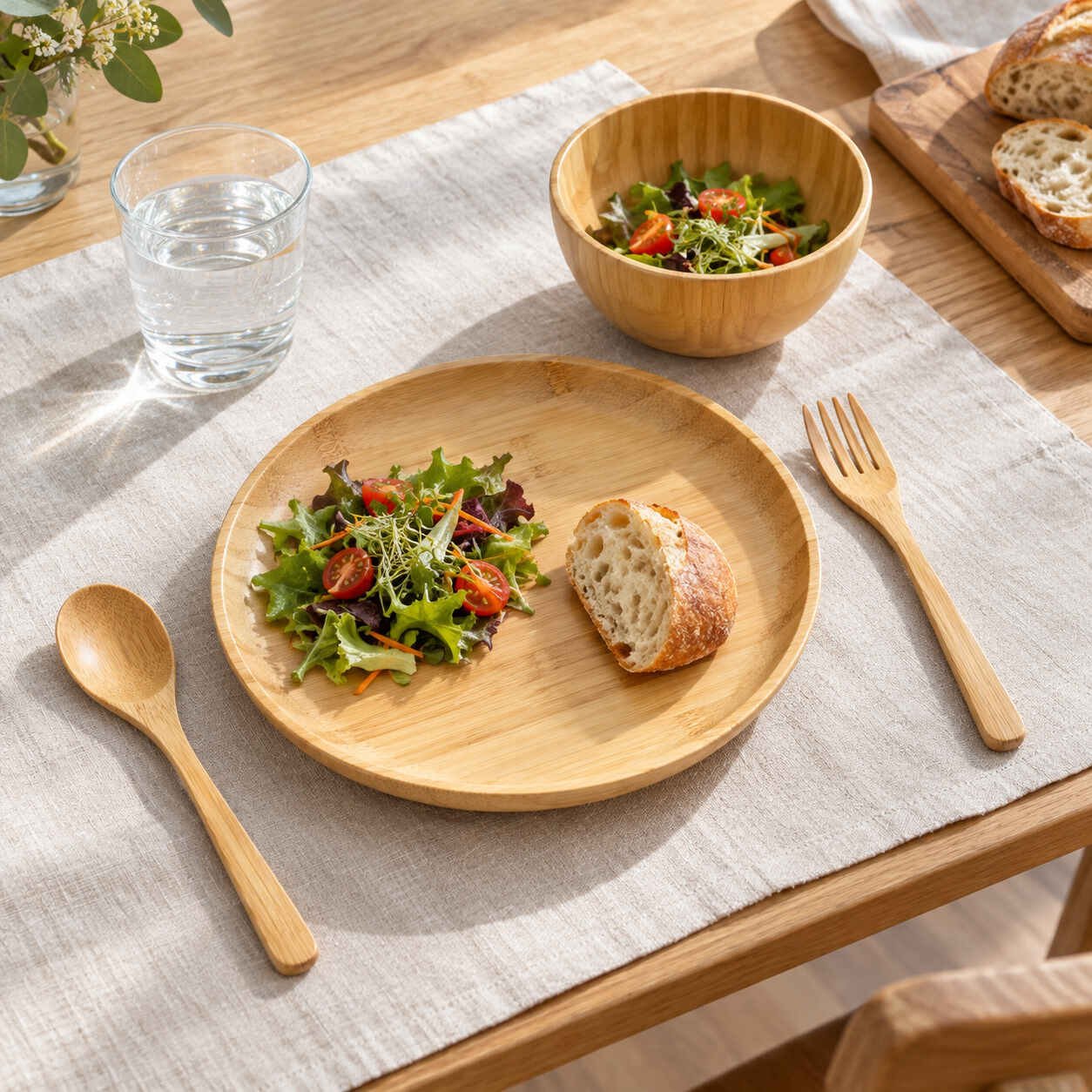
Natural-grain bamboo pieces offer an alternative to glossy white plates or highly decorated dinnerware. Their tones can work well with plain linens, simple glassware, and understated serving accessories.
For a relaxed breakfast, a bamboo bowl can become the visual focus of the place setting. For shared meals, a serving tray can introduce texture without requiring a complete change of dinnerware.
You do not need every piece on the table to match. A restrained combination—such as bamboo serving pieces with existing ceramic plates—can feel more personal than a fully coordinated set.
Different Formats for Different Meals
The category offers more than standard dinner plates. Depending on the supplier, you may find shallow bowls, divided plates, snack dishes, serving platters, and compact utensils.
This variety is useful when the form of the dish matters. A deep bowl may suit a substantial salad, while a shallow dish may make a small snack easier to reach.
Choose the shape around the meal, not the other way around. An attractive plate that is awkward for your usual food will spend more time in a cupboard than on the table.
An Opportunity to Buy More Deliberately
Bamboo tableware can prompt useful questions about sourcing, product lifespan, and disposal. However, the presence of a plant ingredient does not establish the overall environmental performance of a finished product.
The U.S. Federal Trade Commission’s Green Guides emphasize that environmental claims should be supported and appropriately qualified rather than presented as broad, misleading assurances.
A more useful buying question is: “Will this particular product work well enough that I will keep using it?” Clear instructions and realistic expectations are more valuable than an unsupported promise of being universally “green.”
Understanding Food Safety and Material Claims
Food-contact suitability depends on the finished article and its intended conditions of use. A product name, attractive grain pattern, or reassuring slogan does not answer all the relevant questions.
This is an area where careful distinctions matter more than sweeping statements.
Ask About the Complete Finished Product
Before buying, request a material description that covers the body, binders, coatings, printed decoration, and any detachable components that contact food.
Useful questions include:
-
What materials make up the finished item?
-
Does it contain melamine-formaldehyde resin or another plastic binder?
-
What foods and temperatures is it intended for?
-
Is it designed for repeated use?
-
What testing or compliance documentation supports those uses?
-
Do the instructions apply to this exact model?
A generic statement about “bamboo products” is less useful than information tied to the plate or bowl you are purchasing. This is particularly important when buying a large quantity.
Understand the Warning About Bamboo-Melamine Products
The BfR warning concerns bamboo-filled melamine-formaldehyde resin tableware, not every object made from bamboo. The institute advises against using the affected material for hot meals and beverages, including hot drinks served in reusable cups.
Keep that distinction clear when comparing products. A natural-grain bamboo bowl and a molded bamboo-melamine cup should not be treated as equivalent merely because both appear under the same retail category.
If a supplier does not clearly identify the binder in a fiber-based product, ask before buying. If the answer remains unclear, choose a product with better documentation.
Keep Microwave Heating Separate from Serving
A dish used to serve food is not necessarily suitable for heating it.
The U.S. Food and Drug Administration advises against heating food and beverages in melamine-based dinnerware in a microwave. It recommends using cookware specifically identified as microwave-safe.
For bamboo tableware more generally, do not infer microwave suitability from a photograph or the word “natural.” Check the instructions for the exact item. One bamboo children’s tableware manufacturer, for example, explicitly identifies its plates and bowls as unsuitable for microwaves.
A practical routine is to heat food in an appropriate container and use serving dishes according to their own stated limitations.
Treat Finishes and Coatings as Part of the Product
A finish can be an important part of a tableware item, so it should not disappear from the buying conversation.
Ask what the food-contact finish is and whether it requires maintenance. “Food-safe oil” and “protective coating” are not interchangeable descriptions, and neither phrase explains every permitted use.
Avoid applying your own sealant simply because it is marketed for furniture, crafts, or general woodworking. If a surface needs maintenance, use a treatment recommended for that specific food-contact product.
The same principle applies to repairs: a glue that restores the shape of a bowl does not necessarily restore its suitability for serving food.
How to Choose Bamboo Plates, Bowls, and Utensils
Choosing bamboo plates and bowls starts with the meals you serve most often. A breakfast bowl, a dinner plate, and a shared serving dish each need a different balance of size, depth, and handling comfort. Rather than choosing by appearance alone, consider how each piece will work from the first serving to the final wash.
Once the material and intended use are clear, focus on capacity, comfortable handling, storage, and cleaning. The right pieces should fit your usual portions, your available cupboard space, and the care routine you can realistically maintain.
Choose Plates by Usable Space
A plate’s overall diameter can be misleading. A wide rim may leave less space for food than you expect, while a steep edge can change how easily someone cuts or scoops a meal.
Compare the usable eating area as well as the outside measurement.
For a main course, consider whether the plate comfortably accommodates your normal portions. For snacks, smaller plates may be easier to carry and store. For a buffet, a raised edge may be useful, but it should not make the plate awkward to hold.
If buying online, compare the listed dimensions with a plate you already own.
Match Bowl Shape to the Meal
Capacity is only one part of choosing a bowl. Shape influences how food sits, how easily utensils reach it, and how comfortably the bowl can be held.
A broad, shallow bowl may suit a salad or grain-based meal. A smaller bowl may work for snacks or toppings. A deep bowl may be appealing, but its suitability for hot liquids still depends on the product instructions.
Check the base, too. A bowl that looks sculptural in a photograph may be less convenient if it moves easily on your table.
For shared dishes, consider whether guests can comfortably serve from it without reaching across other items.
Inspect Utensils for Comfort and Finish
For bamboo utensils, pay attention to the parts that meet the hand and mouth.
Check fork tips, spoon edges, and handle surfaces. Reject pieces with splinters, sharp roughness, or an uncomfortable shape. If possible, test a sample with the food you intend to serve.
A spoon that works for a small dessert may feel awkward with a substantial meal. A fork that handles salad may not perform well with firmer food.
For a restaurant or event, judge utensils as part of a complete place setting. Guests should not have to change the way they eat simply to accommodate the cutlery.
How to Choose a Bamboo Tableware Set
A bamboo tableware set should include pieces you will use regularly, not simply offer an impressive total number of items. Before ordering, check how many complete place settings it provides and whether the plates, bowls, and accessories suit your normal meals.
For example, a household may benefit more from four practical bowls and four dinner plates than from a larger collection filled with small accessories. Compare the dimensions of each item with dishes you already own, especially when shopping online.
Check whether individual replacements are available. If one plate becomes damaged, replacing it should not require buying another full set.
Finally, consider storage. Measure your shelves, check cupboard depth, and think about how the pieces will stack. A well-chosen set should be easy to use, clean, dry, and put away.
Bamboo Tableware for Everyday Home Dining
The easiest way to introduce bamboo tableware is to begin with a specific role. You do not need to replace every dish in the kitchen at once.
Start with One Regular Meal
Choose a meal that already has a predictable routine. Breakfast, afternoon snacks, or a weekly shared lunch can provide a manageable starting point.
Try a few pieces and notice how they work:
-
Is the portion size comfortable?
-
Are the dishes easy to carry?
-
Do they fit on the drying rack?
-
Does hand washing fit your schedule?
-
Are they fully dry before they return to storage?
This small trial is more informative than buying a large set based entirely on product photography.
Combine Bamboo with Existing Dinnerware
A mixed collection is often more flexible than an all-or-nothing approach.
You might use bamboo for a bread tray or snack bowls while keeping other dishes for meals that require microwave reheating. Alternatively, use bamboo serving pieces when entertaining and retain your usual plates for daily meals.
Give each item a clear function. A coordinated table does not require every material to be identical.
This approach also allows you to assess care requirements gradually. If a few hand-wash items are easy to manage, you can expand the collection later.
Make Care Part of the Purchase Decision
Before buying, picture the end of the meal. Who clears the table? Where do dishes wait? Does everything normally go into a dishwasher?
Many natural bamboo products come with hand-washing instructions. Manufacturer guidance may also prohibit soaking and require thorough drying before storage.bamboobamboo+1
If your household depends on machine washing, that limitation matters. Choosing a different material for everyday plates may be more practical than repeatedly exposing bamboo pieces to conditions their maker advises against.
The right product should work with your habits—or with changes you are genuinely willing to maintain.
Choosing Bamboo Tableware for Children
Children’s tableware needs more than an appealing shape. It should suit the child’s current eating skills, the foods served, and the caregiver’s cleaning routine.
Look Beyond Decorative Shapes
Animal designs and divided plates may make a setting more inviting, but first examine the functional details.
Can the child reach every compartment? Does the plate fit on the high-chair tray? Is the bowl opening suitable for the spoon being used? Are the edges smooth?
A product that works well for small snacks may be less convenient for a complete meal. Consider portion size without assuming a larger dish is always more useful.
Supervise use and inspect pieces regularly. Remove damaged items from service rather than waiting for a small defect to become an obvious failure.
Check Suction Bases and Detachable Parts
Some bamboo plates and bowls include silicone suction bases. Before buying, check the manufacturer’s guidance on suitable surfaces, assembly, cleaning, and age recommendations.
A suction base should be treated as a convenience, not a substitute for supervision.
Pay particular attention to drying. One bamboo children’s tableware manufacturer instructs users to remove the silicone ring so the product can dry fully after washing.
That extra step should be part of the everyday routine. If detachable components are likely to be overlooked, consider whether a simpler design would be easier to maintain.
Plan How Food Will Be Heated
Children’s meals often involve reheating small portions. Decide how that will work before purchasing a set.
If the bamboo product is not microwave-safe, heat food in suitable cookware and transfer it according to the serving dish’s instructions. Melamine-based tableware should not be used for microwave heating.
Do not use a general “safe for kids” statement as a substitute for material disclosure and clear temperature limitations.
The most useful product information explains what the item contains, what it is intended to do, and how caregivers should clean and use it.
Bamboo Tableware for Restaurants and Events
Commercial purchasing requires a different perspective from buying a few bowls for home. The product must fit the menu, service speed, cleaning arrangements, and waste system.
Test Samples with the Actual Menu
Before placing a bulk order, run a small service trial.
Use the foods you intend to serve, in realistic portions, for a realistic length of time. Evaluate handling, comfort, appearance, and whether the tableware performs within its stated limitations.
For disposable pieces, check how the plate behaves when guests carry it. For reusable pieces, include clearing, washing, drying, and storage in the trial.
Avoid judging performance solely from an empty sample. The complete dining experience includes the weight of the food, the utensils used, and the available table space.
Match Reusable Products to the Cleaning Workflow
A reusable product is only practical if the venue can care for it correctly.
If an item requires hand washing, determine whether staff have the time, space, and procedures to do that consistently. Include drying space in the calculation, not merely sink capacity.
Ask the supplier about commercial use rather than assuming household instructions cover restaurant conditions.
Where the cleaning workflow and product instructions conflict, choose another product. A material should not be pushed beyond its intended use simply to preserve a visual theme.
Plan Disposal Before Ordering Disposable Items
For events, establish where used dishes will go before selecting the tableware.
Ask the waste contractor whether it accepts the exact product. If composting is proposed, confirm both the product’s claimed compostability conditions and the facility’s acceptance rules.
The FTC explains that compostable claims need evidence and should be qualified where home composting is unsuitable or appropriate facilities are not widely available.
Make waste stations understandable. A product’s intended destination is of little practical value if guests cannot identify the correct bin or if the local facility will reject the collected material.
What to Check When Buying Bamboo Plates Wholesale
If you are buying bamboo plates wholesale for a restaurant, catering business, or event, compare more than the price per piece. Ask suppliers to confirm the material composition, intended serving conditions, care requirements, and documentation for the exact product you plan to order.
Request samples before committing to a large quantity. Test the plate with your actual menu and normal portion sizes, then assess handling, usable space, and how comfortably guests can eat from it.
Clarify the minimum order quantity, lead time, carton quantity, and policy for damaged deliveries. For reusable plates, ask whether the same model will remain available for replacement orders. For disposable plates, confirm the intended disposal route before making it part of your event plan.
Calculate the total service cost as well. Reusable products may require washing labor, drying space, and replacement stock, while disposable products require storage, backup quantities, and waste collection arrangements.
The right wholesale purchase should fit the complete service process, not just the purchasing budget.
How to Clean and Care for Bamboo Tableware
Care instructions should always come from the maker of the particular product. Bamboo tableware is too varied for one universal washing rule.
For natural bamboo products sold as hand-wash items, a simple, consistent routine is usually easier to maintain than occasional intensive treatment.
Wash Gently After Use
Remove food residue, then wash according to the manufacturer’s directions.
Bambu’s care guidance for its bamboo utensils recommends hand washing with warm water and gentle soap. It also advises against abrasive scrubbers that can scratch the surface.
Choose cleaning tools that remove food without unnecessarily damaging the finish. If residue is difficult to remove, use the maker’s recommended method rather than automatically reaching for a harsh abrasive.
Wash the entire food-contact surface, including edges and recesses. Decorative shapes should not distract from thorough cleaning.
Avoid Prolonged Soaking
Do not leave hand-wash bamboo pieces submerged while attending to other tasks.
Bambu warns that prolonged soaking can lead to discoloration or warping in its utensils. Bamboo bamboo similarly advises against leaving its plates and bowls wet or soaked for extended periods.
A useful household habit is to keep these pieces separate from the soaking sink. Wash them promptly, rinse them as directed, and move them to a drying area.
This also makes it less likely that someone will accidentally include them in a dishwasher load.
Dry Before Stacking or Storing
Cleaning is not finished when the soap has been rinsed away.
Towel-dry as directed and allow enough air circulation for the item to dry fully. Bambu recommends letting bamboo utensils dry completely before storage.
Avoid putting damp pieces into a tightly packed cupboard. Where a product includes a removable base or ring, follow the instructions for separating and drying those parts.
Build drying space into your setup. A small rack or clear section of the counter may be more useful than purchasing extra dishes without somewhere suitable to dry them.
Maintain Only as the Manufacturer Directs
Some bamboo utensils may benefit from a recommended oil treatment, but that does not mean every bamboo plate should be oiled.
Check whether your item has a coating, whether maintenance is required, and which treatment the manufacturer permits.
Bambu advises using an appropriate bamboo or wood care oil rather than ordinary cooking oils that may become rancid.
Do not use oil to hide a problem such as persistent odor, a crack, or a lifting finish. Maintenance should support a sound product, not disguise damage.
Know When to Replace a Piece
Inspect tableware during cleaning. Look for splinters, cracks, separated layers, loose attachments, or a deteriorating food-contact surface.
If damage creates an area that cannot be cleaned reliably, remove the item from food service and ask the manufacturer about replacement or assessment.
Do not assume a repaired piece is suitable for food simply because it looks whole again.
A realistic replacement policy is part of responsible ownership. The aim is not to keep every item indefinitely, but to use it appropriately for as long as it remains fit for its intended purpose.
Evaluating Sustainability and Disposal Claims
Bamboo tableware can look environmentally appealing, but meaningful evaluation requires more than the name of the plant.
Separate the questions of sourcing, manufacture, useful life, and disposal. Evidence about one stage does not automatically answer the others.
Read Broad Claims Carefully
Terms such as “eco-friendly,” “natural,” and “green” can sound reassuring without explaining a measurable benefit.
Look instead for specific statements: what material is used, what certification applies, whether the item is reusable, and what disposal route is supported.
The FTC’s guidance is designed to help prevent misleading environmental marketing and emphasizes substantiation and qualification of claims.
For buyers, this means asking practical follow-up questions. “Compostable where?” and “Plastic-free including which components?” are more useful than accepting a broad statement at face value.
Distinguish Biodegradable from Compostable
Do not treat these terms as interchangeable promises.
For a compostable claim, the FTC says there should be reliable scientific evidence that all materials in the product break down safely into usable compost in an appropriate timeframe. Claims should also address limitations involving home composting and facility availability.
A bamboo ingredient does not establish that a complete item meets those conditions. Coatings, binders, and other components are part of the assessment.
If a seller provides a certificate, check whether it covers the exact product rather than only a raw material or a different item in the range.
Treat Sourcing Certification as One Part of the Picture
Where FSC certification is claimed, ask for identifiable information and check that the claim relates to the product being purchased. FSC monitors bamboo supply chains and has described verification work aimed at identifying false claims and other nonconformities.
Do not treat a sourcing claim as a substitute for food-contact information, appliance instructions, or compostability evidence. Those are separate purchasing questions.
A useful product description should make these distinctions easy to understand rather than grouping every desirable feature beneath a single logo.
Plan for the Product’s Actual End of Life
Before disposal, identify the complete composition and check local acceptance rules.
Do not place a resin-containing composite into compost merely because bamboo appears in its name. Likewise, do not assume a plant-based dish belongs in paper recycling.
For products claimed to be commercially compostable, confirm an accessible facility accepts them. For products without a suitable recovery route, follow local waste guidance rather than improvising.
The most credible disposal instruction is specific enough to act on. If the information is vague, ask the supplier before purchasing a large quantity.
Styling a Table with Bamboo Tableware
Practical decisions should come first, but presentation is still part of the pleasure of using tableware.
Bamboo pieces can work in a variety of settings without making the table feel heavily themed.
Build Around a Small Color Palette
Start with the tone of the tableware and choose a few complementary colors.
For a quiet setting, consider plain napkins, clear glasses, and an uncluttered centerpiece. For a more colorful meal, let the food provide much of the contrast.
You do not need every accessory to have a natural texture. Combining different surfaces can make the bamboo pieces more noticeable.
Keep the arrangement functional: leave enough room for glasses, serving utensils, and comfortable movement around each place setting.
Use Serving Pieces as Accents
A bamboo tray, bowl, or platter can introduce the look without requiring a complete matching collection.
This is especially useful when you already own dinnerware that works well. Choose one or two pieces with a defined purpose, then build the setting around them.
For a shared meal, position serving dishes where guests can reach them comfortably. Avoid overfilling an attractive platter if that makes serving awkward.
The best presentation supports the meal. A beautiful arrangement should still leave room for passing food and clearing used dishes.
Keep Outdoor Dining Manageable
For outdoor meals, prioritize stable placement, comfortable carrying, and an easy clearing plan.
Choose tableware that suits the menu and follow its temperature and weather-exposure instructions. Do not leave reusable pieces outdoors simply because they have a natural appearance.
Prepare a separate place for used dishes so they do not become mixed with waste or left wet overnight.
For a larger gathering, a simple, repeatable place setting usually works better than an elaborate arrangement that requires constant attention.
How to Choose the Best Bamboo Tableware for Your Needs
The best bamboo tableware for your needs is not necessarily the most expensive option or the largest matching set. Start by identifying who will use it, what food it will hold, and how it will be cleaned. A family buying breakfast bowls may have very different priorities from a restaurant selecting serving dishes.
Use the following checklist to compare material information, intended use, dimensions, care requirements, and replacement options. The aim is to choose well-described products that fit a realistic routine, rather than buying on appearance or broad marketing claims alone.
Confirm Material and Intended Use
Ask for a complete description of the product, including any binder, coating, or detachable food-contact component.
Then confirm:
-
Whether it is reusable or single-use.
-
Which foods and serving conditions it is intended for.
-
Whether microwave or dishwasher use is permitted.
-
Which instructions apply to the exact item.
-
What documentation supports the relevant product claims.
If the supplier cannot explain what the item contains, pause the purchase. Clear material information should come before decisions about color, packaging, or quantity.
Check Dimensions, Handling, and Storage
Compare the measurements with items you already use.
Consider plate rims, bowl openings, stack height, cupboard space, and drying arrangements. For children’s products, measure the tray or table where the item will sit.
For bulk purchases, order samples and test them in realistic conditions. Include people who will actually use and clean the products.
A sample trial may reveal a small inconvenience that would become a large problem across dozens of place settings.
Buy for a Realistic Routine
Choose tableware you can maintain consistently.
If hand washing is manageable for a few serving pieces but not for every family plate, purchase accordingly. If an event has no suitable composting arrangement, do not base the decision on compostability alone.
Begin with a useful quantity, keep the instructions, and check replacement availability.
Thoughtful selection is less about finding a universally perfect material and more about matching a well-described product to a clearly understood need.
Frequently Asked Questions About Bamboo Tableware
Is Bamboo Tableware Safe for Everyday Use?
It depends on the finished product, its composition, and how it is used. Ask for clear material information and follow the instructions for food contact, temperature, cleaning, and repeated use.
Pay particular attention to molded bamboo-fiber products. BfR advises against using bamboo-filled melamine-formaldehyde resin tableware for hot foods and drinks. That warning should not be generalized to every item made from bamboo.
Can Bamboo Tableware Go in the Microwave?
Do not assume it can. Check the instructions for the exact product.
Melamine-based dinnerware should not be used to heat food or drinks in a microwave, according to the FDA. Some natural bamboo tableware manufacturers also explicitly prohibit microwave use. Use cookware specifically identified as suitable for microwave heating.
Is Bamboo Tableware Dishwasher-Safe?
There is no universal answer across the category.
Some bamboo products require hand washing, and their instructions should be followed even if another bamboo product is advertised as dishwasher-safe. For example, bamboo bamboo identifies its plates and bowls as hand-wash-only products. Check the model-specific guidance before buying if machine washing is essential to your routine.
What Is the Difference Between Solid Bamboo and Bamboo Fiber?
Natural-grain bamboo products retain a bamboo structure, although construction may include joined sections or finishes. Bamboo-fiber products use fibers or powder within a molded material.
For a fiber-based item, identify the binder. BfR describes certain “bamboo ware” as melamine-formaldehyde resin containing bamboo fibers, which carries specific limitations for hot food and beverage use.
Can Bamboo Bowls Hold Hot Soup?
Only use a bowl for hot soup when its material and manufacturer’s instructions support that use.
Do not infer suitability from the bowl’s depth, appearance, or “bamboo” label. BfR specifically advises against hot foods and drinks in bamboo-filled melamine-formaldehyde resin tableware. Choose a clearly documented product intended for the serving conditions you need.
Is Bamboo Tableware Suitable for Babies and Toddlers?
Evaluate the exact product rather than the category name. Check intended age, dimensions, smoothness, materials, detachable parts, and care instructions, and supervise use.
If a plate has a removable suction ring, follow the cleaning and drying directions. One manufacturer specifically instructs caregivers to remove its silicone ring so the product can dry fully.
How Should I Clean Bamboo Tableware?
Follow the maker’s instructions. For bamboo utensils covered by Bambu’s guidance, the recommended routine is hand washing with warm water and gentle soap, avoiding prolonged soaking, and allowing the items to dry completely before storage.
Do not apply those instructions automatically to every composite or coated product. Its own material and finish may require different care.
Should I Oil Bamboo Plates and Bowls?
Only if the manufacturer recommends it for that product.
Some bamboo utensils have an oil-care routine, while other items may have finishes that require different maintenance. Bambu recommends an appropriate care oil for its utensils and cautions against ordinary cooking oils that can become rancid. Do not oil a damaged piece as a substitute for assessing whether it remains usable.
Is Bamboo Tableware Compostable?
Some products may have a supported compostability claim, but the word “bamboo” is not enough to establish it.
The FTC says compostable claims require reliable evidence covering all materials in the item. Instructions should clarify relevant limitations, including whether home composting is suitable and whether an appropriate facility is available. Confirm acceptance locally before putting tableware in a compost collection.
Is Bamboo Tableware Always Plastic-Free?
No. Products marketed as bamboo tableware can include plastic-based binders.
BfR’s description of bamboo-filled melamine-formaldehyde resin products is one example. Ask for the complete composition, including coatings and attachments, rather than relying on a plant-based name or natural-looking color. A clear material declaration is more informative than appearance alone.
How Long Does Reusable Bamboo Tableware Last?
There is no reliable lifespan that applies to every product. Construction, frequency of use, care, and storage all influence when replacement becomes necessary.
Instead of relying on a fixed number of years, inspect pieces regularly. Remove items with splinters, cracks, separated components, or food-contact surfaces that can no longer be cleaned reliably. Follow the manufacturer’s assessment and replacement guidance.
What Should I Buy First?
Start with a few pieces that serve a clear purpose: breakfast bowls, snack plates, or a serving tray.
Choose products with transparent material information and care requirements you can realistically follow. Use them through several meals before expanding the collection.
The best starting point is not the largest set. It is a small, well-chosen group of pieces that earns a regular place at your table.



Leave A Comment