
Bamboo living room furniture can make a space feel relaxed, welcoming, and thoughtfully put together. Whether you picture an open-frame sofa with generous cushions or a streamlined coffee table with a smooth finish, the starting point is the same: choose furniture that supports the way you actually live.
The most appealing room is not necessarily the one with the most bamboo. It is the one where seating feels comfortable, tables are easy to reach, storage works, and natural textures have room to stand out. A single bamboo chair can introduce warmth to an existing arrangement. A coordinated sofa and table can establish the direction of an entire room.
This guide focuses on styling ideas, furniture selection, material questions, and practical buying decisions—the connected approach outlined in the supplied document. Rather than treating bamboo furniture as a single look, it explores how to build a living room around your space, preferences, and daily routines.
Start With the Living Room You Want to Use
Before comparing bamboo living room furniture, think about what happens in your living room on an ordinary day. Do you stretch out with a book, host friends, watch television, work from the sofa, or share the space with children and pets?
These activities should shape your choices more than a beautifully staged photograph.
A low, deep sofa might look inviting but feel awkward for someone who prefers upright seating. A large coffee table may suit entertaining but interrupt the route through a narrow room. An open shelf can display favorite objects beautifully, yet it may not solve a household’s need to hide everyday clutter.
Identify Your Main Priorities
Write down three things your new furniture must do. For example:
-
Provide comfortable seating for two people every evening.
-
Leave a clear route between the doorway and balcony.
-
Store books, charging cables, and television accessories.
Then list the qualities you would enjoy but could compromise on, such as matching side tables or a particular cushion color.
This distinction keeps the shopping process grounded. If a beautiful bamboo furniture set fails your essential requirements, it is not the right set for your home.
Decide How Much Bamboo You Want
You can introduce bamboo at several levels.
An accent approach might mean one chair or a coffee table. A mixed-material room could combine a bamboo sofa frame with upholstered chairs and a painted cabinet. A coordinated arrangement might use bamboo for the sofa, tables, and storage.
None is automatically better. As a styling exercise, start with the smallest combination that achieves the atmosphere you want. You can always add another piece after living with the first purchases.
Understand What You Are Buying
“Bamboo furniture” does not tell you everything about a product. Two pieces carrying that description may differ in appearance, construction, finish, upholstery, and maintenance requirements.
Before comparing prices, establish what the listing actually describes. Is bamboo used in the main frame, the tabletop, the decorative panels, or only a small component? Does the seller explain the construction clearly?
The uploaded guide specifically recommends checking materials and construction rather than grouping different products together under one general label. That is a useful principle for every buying decision that follows.
Round-Pole and Open-Frame Designs
If you like a relaxed, organic appearance, consider designs that visibly celebrate rounded bamboo elements. Look for a silhouette you enjoy from several angles, not just the front.
Open sides and exposed frames can become a major decorative feature. Before buying, however, examine where your arms and back will rest. Ask whether the cushions cover the contact points comfortably and whether they remain in position when someone sits down.
Also consider the view behind the sofa. If the furniture will stand away from a wall, the back becomes part of the room’s design.
Modern Bamboo Furniture With a Streamlined Look
If you prefer an understated interior, consider modern bamboo furniture with simple profiles and carefully chosen proportions. For your living room, focus on how a coffee table, cabinet, or seating frame will work alongside the pieces you already own. You do not need to repeat the same material everywhere; one well-chosen item can become the starting point for a balanced arrangement.
You do not need an overtly rustic frame to include bamboo in a modern living room. Greenington, for example, describes its furniture as made from solid Moso bamboo and provides care instructions for finished surfaces comparable to the care given to fine hardwood furniture.
For a contemporary scheme, evaluate the piece as you would any other substantial furnishing: proportions, edges, hardware, storage layout, and finish should all make sense.
Ask the retailer to clarify construction terms. A smooth photograph is not a substitute for a useful material specification.
Bamboo, Rattan, and Woven Details
Do not assume that every natural-looking frame or woven panel is bamboo. Bamboo and rattan are different materials; the distinction should be clear in a reliable product description.
For mixed-material furniture, ask which material forms the structural frame and which forms the seat, back, or decorative infill. If the listing simply says “natural furniture,” request more detail.
This matters when you compare products, order replacement components, or follow care instructions. Buy the piece because its construction and appearance suit your needs, not because several material names have been used interchangeably.
Bamboo Living Room Furniture Ideas for Different Styles
A useful styling plan gives your room direction without making every decision rigid. Choose a mood, a small color palette, and a few recurring shapes. Then let individual pieces contribute something different.
The following schemes are design suggestions rather than rules. Adapt them to your architecture, existing furniture, and preferred level of color.
A Soft, Neutral Living Room
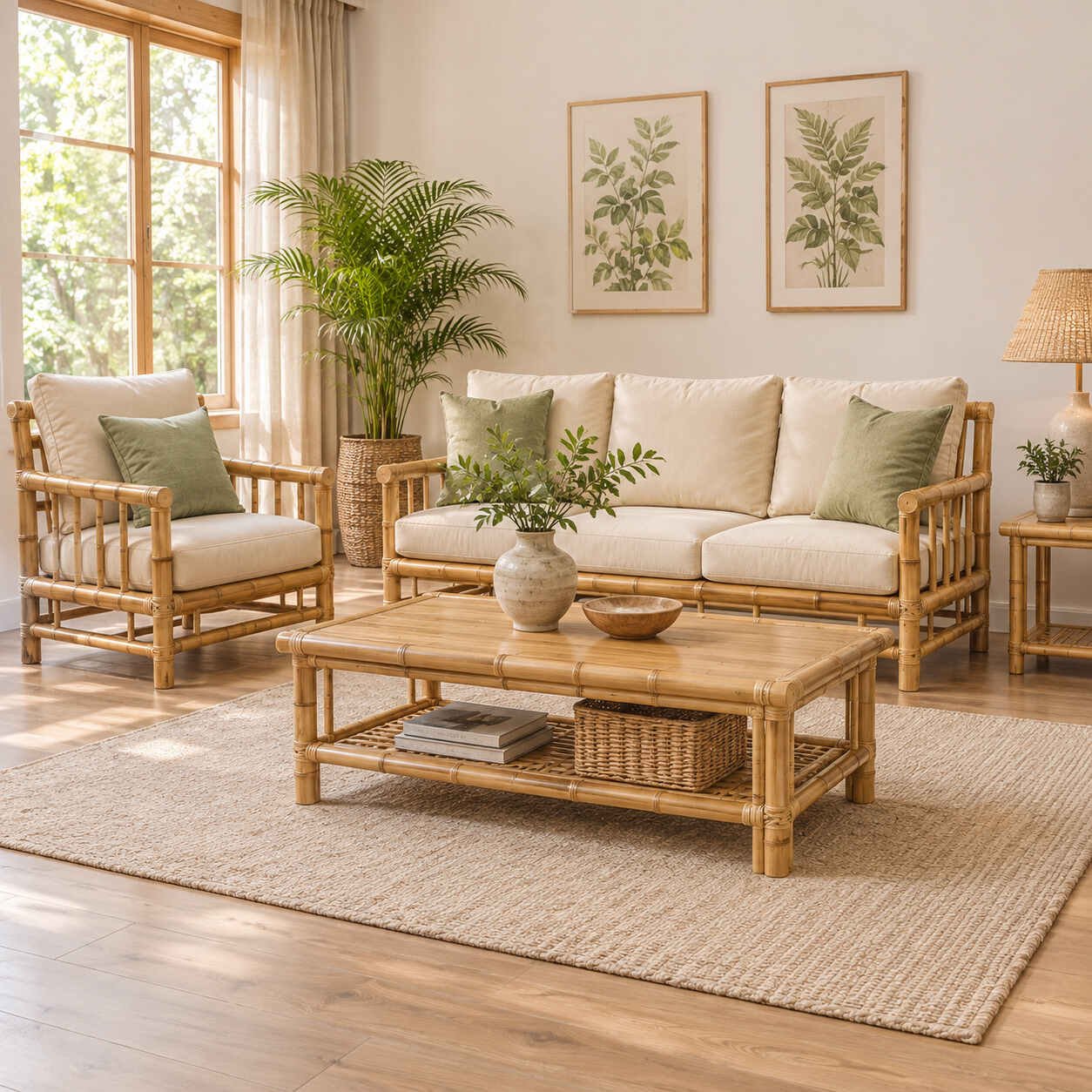
For a calm arrangement, start with a bamboo sofa or pair of chairs and cushions in cream, oatmeal, or warm gray. Add a rug that relates to the upholstery rather than trying to match the frame exactly.
Keep the larger surfaces quiet, then introduce variation through texture. A loosely woven throw, a matte ceramic lamp, and a plain side table can provide enough contrast.
The goal is not to make everything beige. A deeper accent—perhaps an olive cushion or charcoal picture frame—can give the room definition.
Before committing, place fabric and finish samples together in your own room. Choose the combination that feels comfortable there, not merely the one that resembles an inspiration image.
Modern Bamboo Living Room Furniture: Clean Lines and Comfortable Details
When choosing modern bamboo living room furniture, start with simple silhouettes and a clear purpose for each piece. Consider a rectangular coffee table, a sofa with an uncluttered profile, and storage that keeps everyday objects organized. Build the arrangement around comfortable seating and useful surfaces rather than adding furniture simply to complete a matching collection.
Introduce contrast with a dark lamp, a slim metal side table, or a large piece of artwork. Use a few substantial accessories rather than many small ornaments.
If the bamboo frame has visible joints or repeated lines, let those details do some of the decorative work. There is no need to repeat every pattern in the cushions, rug, and wall art.
A modern room can still feel comfortable. Prioritize generous seating and useful lighting over an arrangement that looks impressive but offers nowhere to put a drink.
A Coastal-Inspired Room Without the Theme
To suggest a coastal atmosphere, combine bamboo furniture with pale upholstery, soft blue or sea-green accents, and a relatively uncluttered layout.
Avoid feeling obliged to add nautical objects. You can create the mood through color and openness instead.
Try a natural-toned frame, white curtains, a muted blue cushion, and one large landscape print. Keep the coffee table practical and leave enough free surface for daily use.
For a more grounded version, introduce a darker rug or a brown leather accent. This can help the room feel like a year-round home rather than a temporary holiday setting.
A Collected, Colorful Living Room
If you enjoy pattern, use bamboo furniture as part of a layered scheme. Pair a relatively simple frame with patterned cushions, artwork, and a rug that brings several colors together.
Choose one connecting element. It might be a repeated rust tone, a family of greens, or curved shapes appearing in the chair, mirror, and lamp.
Then vary the scale. A large pattern can sit alongside a smaller one more intentionally than several equally busy prints competing for attention.
Leave some areas visually quiet. An undecorated tabletop or plain wall can help favorite pieces remain noticeable.
A Mixed-Material Everyday Room
You do not need to replace serviceable furniture to create a coherent room. A bamboo accent chair can sit beside an upholstered sofa you already own. A bamboo table can work with painted storage and a fabric ottoman.
Build a connection through proportion, color, or shape rather than demanding an exact material match.
For example, repeat the rounded arm of a bamboo chair in a circular side table. Or connect a warm frame with a similar tone in artwork.
This approach gives each purchase a clear role and avoids buying an entire collection simply because the pieces are available together.
Choose the Right Bamboo Sofa and Chairs
Seating deserves the most careful attention because it determines how the room feels in use. A beautiful coffee table cannot compensate for a sofa you avoid sitting on.
When possible, test the exact model. If that is not practical, ask detailed questions and check the return conditions before ordering.
Look Beyond the Overall Dimensions
Overall width and depth tell you whether a sofa fits the room, but not whether it fits your body.
Ask for the seat height, usable seat depth, arm height, and back height. Clarify whether the stated seat height includes the cushion.
Think about how you prefer to sit. If you like upright conversation, compare the support offered in that position. If you curl up or stretch out, check the usable space between the arms.
Mark the footprint on your floor before purchasing. Then place a temporary object at the approximate back height to help judge how substantial the sofa will feel.
Treat Cushions as Part of the Furniture
Do not treat cushions as an afterthought. Ask what is included, how the covers are cleaned, whether the filling is replaceable, and how the cushions are secured.
Tine K Home offers cushions and mattresses sized for specific bamboo furniture models, illustrating why matching the cushion to the frame matters. Its range includes options for chairs, sofas, and lounge furniture.
When comparing products, check whether photographs show optional back cushions that are not included in the advertised price.
Also consider future replacement. A frame you love becomes a more practical purchase when you know how you will maintain or replace the soft components.
Check Comfort in Real Positions
During a showroom visit, sit as you normally would at home rather than briefly perching on the edge.
Lean back. Rest your arms. Stand up again. If you share the sofa, test it together.
Notice whether you contact an exposed rail, whether a cushion shifts, and whether the seat supports the position you prefer. Ask whether the display model’s cushion specification matches the one you would receive.
Comfort is personal. A firm, supportive chair can be ideal for one person and unsuitable for another, so avoid relying on broad labels such as “luxurious” or “deeply comfortable.”
Build a Balanced Furniture Arrangement
A living room needs more than attractive individual pieces. The relationship between seating, tables, storage, and circulation determines whether the room works.
Begin with the main seat and its view. That might be toward a television, fireplace, window, or another seating group. Arrange the remaining furniture around the activity you want to encourage.
Choose a Coffee Table With a Clear Job
Ask what your coffee table needs to hold. Drinks and a book require a different surface from board games, shared snacks, or a large decorative display.
For a narrow arrangement, experiment with an oval or round footprint. For a longer sofa, compare a rectangular table with two smaller tables.
Use cardboard or tape to test the size. Sit down and check reach, then walk around the arrangement.
If you prefer an upholstered ottoman, decide where drinks will go. A stable side table may be more convenient than relying entirely on a tray.
Use Side Tables Where People Sit
Place tables according to use rather than symmetry alone. A chair in a reading corner needs somewhere to set a cup even if it stands apart from the main sofa.
Consider the relationship between the tabletop and the chair arm. Try the height before buying if possible.
One substantial table may work better than several tiny ones, particularly if you need space for a lamp and everyday objects.
If you choose different table styles, give them a connection. Similar proportions, a repeated color, or a shared shape can make the arrangement feel intentional.
Make Storage Specific
List what you need to store before selecting a cabinet.
Measure books, baskets, game consoles, and other bulky items. Check internal dimensions rather than relying on the cabinet’s exterior size.
For a media unit, confirm cable access, equipment clearances, and any ventilation requirements specified by the electronics manufacturer.
Choose open storage for things you want to see and closed storage for things you prefer to hide. A room can include both.
The best bamboo storage piece is not necessarily the largest one. It is the one whose interior suits the objects that otherwise end up on your floor or coffee table.
Should You Buy a Bamboo Living Room Furniture Set?
A bamboo living room furniture set offers a coordinated starting point, but every included piece should earn its place in your room. Before choosing a package, check whether the sofa provides the seating you need, the chairs fit your layout, and the tables leave enough room to move comfortably. A matching finish is appealing, but comfort and practical dimensions should guide the final decision.
A coordinated set offers a straightforward starting point, while individual purchases allow more flexibility. The right choice depends on how closely the package matches your room.
Compare the actual pieces rather than assuming a set is automatically more convenient or better value.
When a Matching Set Makes Sense
A set is worth considering when you are furnishing an empty room and every included item has a useful role.
Check the sofa, chairs, and tables separately. Would you still choose each piece if it were sold alone? Does the coffee table fit, or are you accepting it only because it comes with the sofa?
Ask what is included in the package price, including cushions, assembly, and delivery.
A coordinated set can establish a clear foundation. You can personalize it through lighting, a rug, artwork, and textiles rather than requiring every major piece to be different.
When to Mix Individual Pieces
Buy separately when you already own useful furniture, need a particular seat size, or want a less coordinated appearance.
A practical starting combination might be one bamboo accent chair and a table. Live with them before deciding whether the room needs more.
This is also useful when your priorities differ by category. You might prefer a fully upholstered sofa for daily lounging but want bamboo for tables and storage.
Keep a simple record of measurements, finishes, and photographs as you shop. Comparing those details is more reliable than trying to remember whether two items will work together.
Plan Bamboo Furniture for Small and Large Rooms
Room size changes the decisions you need to make, but it does not dictate a single furniture style. A small room can accommodate a strong statement piece, while a large room may work best as several modest groups.
Start with the routes people need to take and preserve those routes as you add furniture.
Small Living Rooms
For a compact room, decide which seats are essential. Do not automatically buy a sofa and two chairs because that arrangement appears in a catalog.
You might prefer a two-seat sofa and one comfortable chair, or a sofa with movable occasional seating.
Test doors, drawers, and walking routes on your plan. Include the space needed to pull out a basket or open a cabinet.
If storage is limited, give each purchase a defined task. A side table with a useful shelf may serve you better than an extra decorative stool that has no regular purpose.
Narrow or Open-Plan Spaces
In a narrow room, position the main furniture so that moving through the space does not require weaving between tables.
Try an asymmetrical layout if a symmetrical one blocks circulation. One chair and a lamp may work better than a matching pair.
In an open-plan space, use the seating arrangement to establish the living area. A sofa facing two chairs can suggest a conversation zone without adding a physical partition.
Review the room from adjoining areas, too. The backs and sides of your bamboo furniture may be as visible as the fronts.
Larger Living Rooms
Avoid assuming that a large room needs every piece to be oversized. Consider creating a main seating group and a separate reading corner.
Use each area for a distinct activity, and provide appropriate tables and lighting.
If your bamboo furniture has a relatively delicate appearance, test it within the full room plan. You may want a larger rug, a substantial upholstered companion piece, or broader storage to balance the composition.
Do not fill the perimeter automatically. Arrange furniture where conversation and daily use feel natural, then evaluate the remaining space before adding anything else.
Choose Colors, Fabrics, and Accessories
Once the main furniture is settled, textiles and accessories can give the room personality. Approach them as a connected group rather than a sequence of unrelated purchases.
Start with the colors already present in the frame, flooring, and walls.
Build a Manageable Palette
Choose a main neutral, a supporting color, and an accent. For example, you might combine warm white upholstery, muted green textiles, and small rust-colored details.
Use samples to compare the materials in your room. Look at them during the day and with your evening lighting.
You do not need identical tones throughout. The aim is a combination you enjoy seeing together.
If your furniture already contains strong visual detail, consider keeping the largest fabric areas relatively simple and introducing pattern in smaller, replaceable elements.
Select Upholstery for Your Household
Ask how each fabric is cleaned and whether the cover can be removed. Removable does not necessarily mean machine washable, so follow the stated instructions.
Consider what matters most in your home: texture, appearance, ease of care, replacement availability, or a particular feel against the skin.
Request fabric samples when possible. Compare them with your flooring and existing furnishings.
Avoid choosing solely from lifestyle photographs. A close-up sample and a clear care label tell you more about whether a fabric suits your routine than an attractive room setting does.
Finish With Useful Details
Choose accessories that contribute something beyond filling space.
A reading lamp should illuminate the seat where you read. A basket should fit the objects you plan to store. A rug should support the arrangement you have drawn rather than forcing the furniture into awkward positions.
For a final styling pass, remove anything that feels repetitive. If the bamboo frame already provides a strong linear pattern, the room may not need several additional woven accents.
Leave some open surfaces. A living room should have space for the things you bring into it every day.
How to Compare Bamboo Living Room Furniture Brands
When comparing bamboo living room furniture brands, look beyond the overall appearance of a collection. Check the specifications of the individual pieces you are considering, including their materials, dimensions, cushion options, care instructions, and replacement components. Use the same questions for every brand so that your final choice reflects your household’s needs rather than a particularly appealing photograph.
Two Different Starting Points
If you are exploring open-frame bamboo seating with coordinated cushions, Tine K Home provides examples of model-specific sofa and chair cushion options. Review the exact frame, cushion package, and care requirements together.
If you prefer solid bamboo furniture with finished surfaces, Greenington provides a different starting point. Its published care guidance identifies solid Moso bamboo and gives instructions for cleaning, protecting, and positioning the furniture.
These are examples to investigate, not a universal ranking. Compare the particular products available to you and verify current terms with the seller.
Ask for Information That Changes the Decision
Useful questions include:
-
What are the full and usable dimensions?
-
Which components are bamboo?
-
What cushions and accessories are included?
-
What assembly is required?
-
Are replacement covers, cushions, or hardware available?
-
What is the manufacturer’s stated care routine?
-
What delivery service is included?
-
What happens if the furniture arrives damaged?
Ask about load limits where relevant, particularly if the listing does not provide them.
If an answer is important to your purchase, keep it in writing. Clear information makes it easier to compare options without being distracted by different marketing descriptions.
Comparing Bamboo Living Room Furniture for Sale
When browsing bamboo living room furniture for sale, compare the complete offer rather than the headline price. Check whether the listing includes seat cushions, back cushions, required hardware, and any accessories shown in the photographs. Confirm the selected size and finish before adding the item to your cart.
Keep a shortlist with the same details for each option: dimensions, included components, total delivered cost, estimated delivery time, and return conditions. If a listing leaves an important question unanswered, ask the seller for clarification before paying. A purchase should make sense for your room and budget, not simply look attractive in a promotional image.
Check Delivery and Returns Before Paying
Measure the delivery route as well as the final position. Include doorways, stair turns, lifts, and any narrow passages.
Ask whether the furniture arrives assembled, partly assembled, or flat-packed. Confirm whether packaging removal or room placement is included.
Read the return conditions for large furniture, customized upholstery, and sale items. Find out who pays collection costs and whether original packaging must be retained.
A product that looks affordable can become an inconvenient purchase if you have not checked how it reaches your room or what happens if it does not fit.
Budget for the Complete Living Room
Set a budget for the finished arrangement, not just the main furniture. Seating, tables, cushions, delivery, lighting, and a rug may all compete for the same funds.
Before ordering, build a complete list and identify which purchases can wait.
Put Money Where You Will Notice It
If you use the sofa every evening, give comfort and suitable dimensions priority. If you work or read in an accent chair, evaluate that chair carefully rather than treating it as decoration.
You can simplify less important parts of the room. An existing side table may serve perfectly well while you save for the right storage piece.
Avoid spreading the budget across too many compromises. One carefully chosen bamboo item can establish the look while you keep other useful furniture.
Compare the Full Cost
For each shortlisted product, record the item price, required cushions, delivery, assembly, and any immediately necessary accessories.
Then compare what you are actually receiving.
A sofa shown with several cushions may not include all of them. A table may require assembly you would prefer to pay for. A replacement cover may be sold separately.
The purpose is not to identify the lowest headline price. It is to understand which option provides the most suitable complete solution within your budget.
Care for Bamboo Living Room Furniture According to Its Finish
There is no single maintenance routine suitable for every bamboo product. Follow the instructions for the specific item, especially before applying oil, polish, cleaning chemicals, or water.
The distinction is important: Greenington advises against wax and polish for its furniture, while Tine K Home describes an oil-based maintenance routine for its particular seasonal outdoor bamboo range. Those instructions should not be transferred indiscriminately between products.greenington+1
Establish a Simple Indoor Routine
For its furniture, Greenington recommends dusting with a soft, dry cloth, wiping spills promptly, and using a gentle wood-furniture cleaner for periodic cleaning. It also advises using coasters and protective pads and avoiding abrasive, oil-based, acidic, or caustic products.
Treat this as brand-specific guidance, not permission to use the same cleaner on every finish.
Keep your furniture’s care sheet somewhere accessible. If a spill or mark occurs, you should not have to guess which treatment is appropriate.
Pay Attention to Placement
Greenington advises keeping its furniture away from heat vents, fireplaces, wood stoves, and prolonged direct sunlight. It recommends relative humidity between 40 and 55 percent for its solid bamboo furniture to reduce the risk of checking or warping.
Use the requirements of your chosen product when planning its position.
If a location exposes furniture to concentrated heat or persistent moisture, raise that concern with the seller before purchase. It is better to choose a suitable item or another position than to depend on an improvised maintenance routine.
Separate Indoor and Outdoor Use
A relaxed appearance does not establish outdoor suitability.
Tine K Home states that its bamboo furniture requires protection from moisture and intense sun and is not suitable for year-round outdoor use. Its guidance includes dry, ventilated seasonal storage and removing cushions when the furniture is not being used.
For a sunroom, covered terrace, or room opening directly onto a garden, describe the conditions accurately to the retailer.
Confirm the suitability of both the frame and cushions. Do not assume that permission to use one component outdoors automatically applies to the complete arrangement.
Avoid Common Buying and Styling Mistakes
Most disappointing purchases can be traced to a mismatch between the furniture and the room, rather than the material alone.
A useful final review is to imagine an ordinary evening in the completed space.
Do Not Buy From the Photograph Alone
A photograph can introduce a style you love, but it cannot confirm seat comfort, usable storage, or the size of the delivery route.
Return to measurements and specifications before making the decision.
Ask yourself where you would put a drink, how you would turn on a lamp, and whether two people could pass through the room comfortably.
If you cannot answer those questions, refine the plan before ordering more furniture.
Do Not Confuse Coordination With Repetition
A room can feel connected without repeating bamboo in every object.
Instead of adding another woven accessory automatically, consider whether the room needs a different texture, a quieter surface, or simply less decoration.
Repeat selected elements deliberately: a curve, a color, or a proportion.
The aim is a living room that feels personal and usable, not one in which every purchase announces the same material.
Do Not Ignore Future Maintenance
Before buying, decide how you will clean cushions, replace worn components, and follow the finish-care instructions.
Ask whether replacement parts are standard products or special orders.
Keep receipts, model names, fabric references, and care documents together. These small preparations make ownership more straightforward.
A piece that suits your routine from the beginning is a better choice than one that requires you to adopt maintenance habits you already know you will dislike.
Bring Your Bamboo Living Room Together
Start with the main seat, establish a practical arrangement, and add tables and storage for clear reasons. Then use color, lighting, and textiles to make the room feel like yours.
Bamboo living room furniture does not need to define every surface. It can be the central feature of a coordinated scheme or one warm element in a more varied interior.
Before making the final purchase, review your original priorities. Check that the room supports daily life, not just the look you hoped to create. The strongest result is a space where attractive furniture and ordinary routines fit comfortably together.
FAQ About Bamboo Living Room Furniture
Is bamboo living room furniture suitable for everyday use?
It can be, but assess the specific product rather than relying on the material name. Check intended use, construction information, stated load limits, cushion support, and care requirements. For seating, test the model where possible or choose a retailer whose return conditions you understand.
Does bamboo furniture work in a modern living room?
Yes. As a design approach, combine simple bamboo pieces with restrained colors, comfortable upholstery, and a few contrasting materials. You might use bamboo only for the coffee table and storage, or make an open-frame sofa the focal point. Keep the arrangement practical rather than forcing a fully matched look.
Should I buy a complete bamboo living room furniture set?
Choose a set when each included piece suits your space and needs. Compare every item individually before deciding. If the sofa is right but the chairs or table are not, buying separately may produce a better room. A coordinated finish should not outweigh comfort, useful dimensions, or clear circulation.
What colors should I pair with bamboo furniture?
Try warm white, oatmeal, muted green, soft blue, charcoal, or earthy accents as starting points. These are styling options, not fixed rules. Compare samples with the actual furniture finish, flooring, and lighting in your home, then choose the combination you most enjoy.
Can I mix bamboo furniture with my existing sofa?
Yes. Start by finding a visual connection, such as similar curves, compatible proportions, or a repeated warm tone. A bamboo chair or coffee table can introduce the material without replacing your sofa. Add only what the room needs rather than building a matching collection automatically.
Are bamboo and rattan furniture the same?
No. Bamboo and rattan are different materials, even though product photographs and descriptions may place them in similar decorative settings. Check the listing for the frame material and any woven components, especially when a piece combines several materials.
Can indoor bamboo living room furniture go outside?
Only use it outdoors if the manufacturer explicitly permits that use. Requirements may still include weather protection and seasonal storage. Tine K Home, for example, states that its bamboo range is not suitable for year-round outdoor use and provides specific protection and storage instructions.
Should I oil or polish bamboo furniture?
Not without checking the product’s instructions. Greenington advises against wax and polish for its furniture, while Tine K Home specifies an oil treatment for its particular seasonal outdoor bamboo products. The appropriate routine depends on the construction, finish, and intended use.greenington+1
What should I check before ordering bamboo furniture online?
Confirm dimensions, materials, included cushions, assembly requirements, care instructions, and replacement options. Measure the delivery route and read the damage-reporting and return conditions. If comfort is a major concern, ask detailed questions about the seat and cushions before paying, rather than relying on descriptive labels alone.


Leave A Comment